

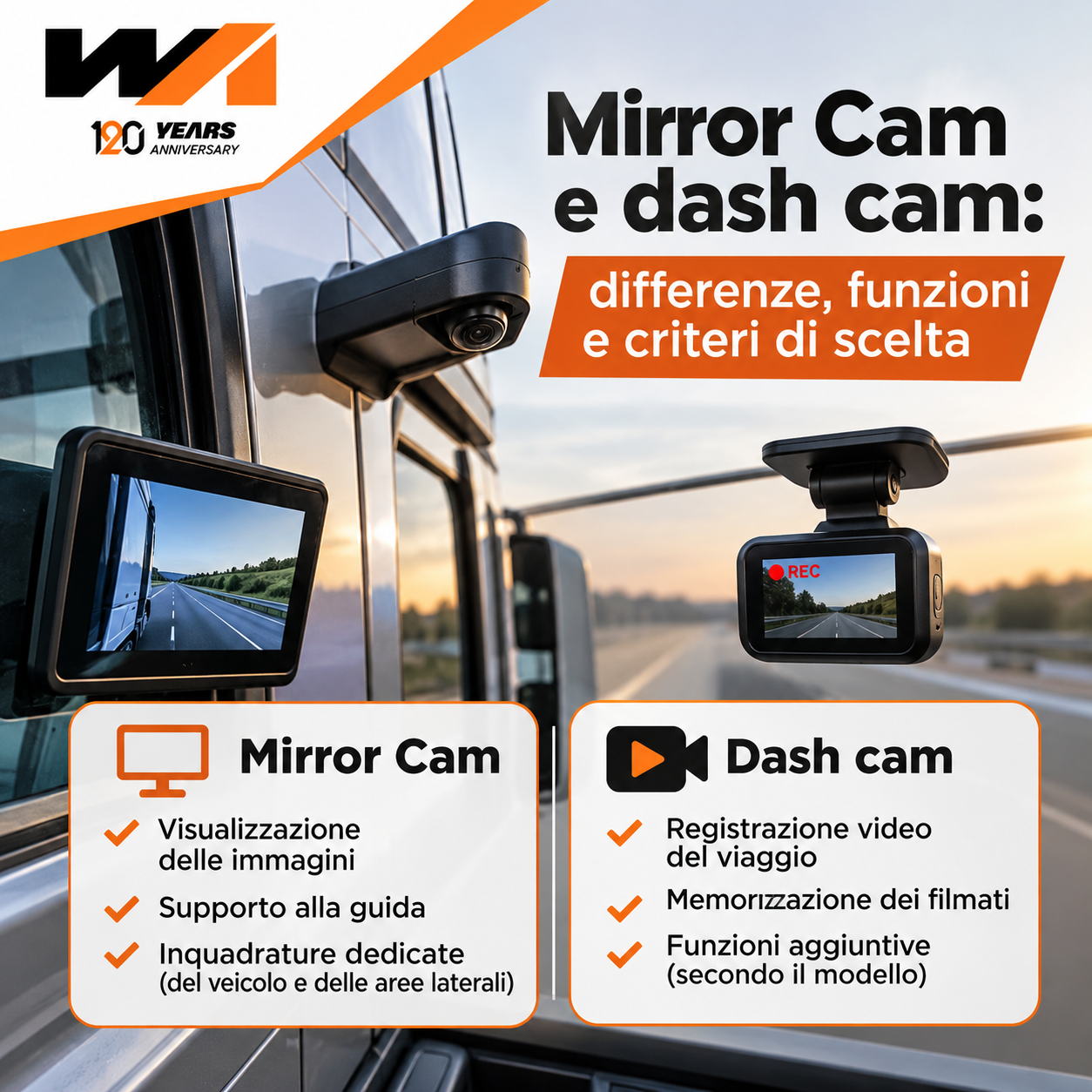
Mirror Cam and dash cam: differences in function and selection criteria for industrial vehicles
Mirror Cam and dash cam for trucks: differences, functions and selection criteria
The Mirror Cam and dash cams for trucks they are solutions based on the use of cameras, but can respond to different operational needs.
Mirror Cam systems are mainly associated with viewing images from external cameras, while dash cams are mainly used to record what happens during the journey.
For those who operate in the industrial vehicle sector, understanding this distinction is important to identify a solution consistent with the characteristics of the vehicle and the needs of use.
The choice should not be based only on image resolution or the number of cameras available, but above all on the required function, compatibility and technical specifications declared by the manufacturer.
In this in-depth study, Way Assauto analyzes the main differences between Mirror Cam and dash cam, the parameters to evaluate and the aspects to consider before installation.
What is meant by Mirror Cam?
In commercial comparison, the expression Mirror Cam is used to indicate systems that show images from external cameras on monitors. Names and functions may change depending on the manufacturer.
The central function is visualization while using the vehicle. Position of the cameras, fields of view and layout of the screens depend on the configuration.
A system designed to replace specific rear-view mirrors must be distinguished from an additional camera. The presence of a monitor does not, in itself, prove that it is possible to eliminate the truck's mirrors.
What is a dash cam for trucks used for?
The truck dash cam is mainly intended for recording images. It usually picks up the road in front of the vehicle; some configurations include additional channels for other shots.
Depending on the model, cyclic recording, protection of footage associated with an event, localization or remote access may be available. These characteristics must be verified in the technical data sheet.
In cyclic recording, older files are progressively overwritten according to device logic. Memory capacity, resolution and number of cameras affect the time available before overwriting.
Viewing and recording: the main difference
A monitor camera system allows you to observe a shot while the vehicle is being used. A dash cam stores footage that can be accessed later.
The two functions can coexist in the same system, but should not be taken for granted. A monitor that is turned on does not confirm that images are recorded; similarly, a camera that records is not automatically suited to performing a rear view function.
Before purchasing, you need to clarify whether you need to see, register or have both options.
What characteristics should you evaluate before choosing?
To compare truck cameras, resolution is only one of the parameters. Field of view, installation position, monitor readability and image continuity are also important.
For systems intended for display, video delay, contrast management and behavior under expected operating conditions should be examined.
For truck video recording, you need to check supported memory, management of protected files, export mode and error reporting. The availability of images also depends on the correct configuration and maintenance of the device.
Compatibility and installation on industrial vehicles
The choice must consider electrical power supply, wiring, fixings, dimensions and declared environmental conditions. A device designed for a car is not automatically suitable for any truck.
The placement of the display also requires attention: it must allow consultation without obstructing the driver's view.
Before installation it is advisable to check the manufacturer's documentation and the suitability of the system for the intended function. Any ability to register, service or replace mirrors requires specific confirmation.
How to direct your request to Way Assauto
To evaluate a solution from the Mirror Cam Way Assauto range, describe the vehicle and the operational objective: which areas you want to view, where the monitor will be installed and whether the footage needs to be preserved.
Providing the vehicle model, current configuration and usage needs allows for a more precise comparison of the available features.
The effective choice arises from the correspondence between need, documented function and installation compatibility. To learn more about the solutions, consult the section Mirror Cam or contact the Way Assauto team with the vehicle data.
Leave a Reply