

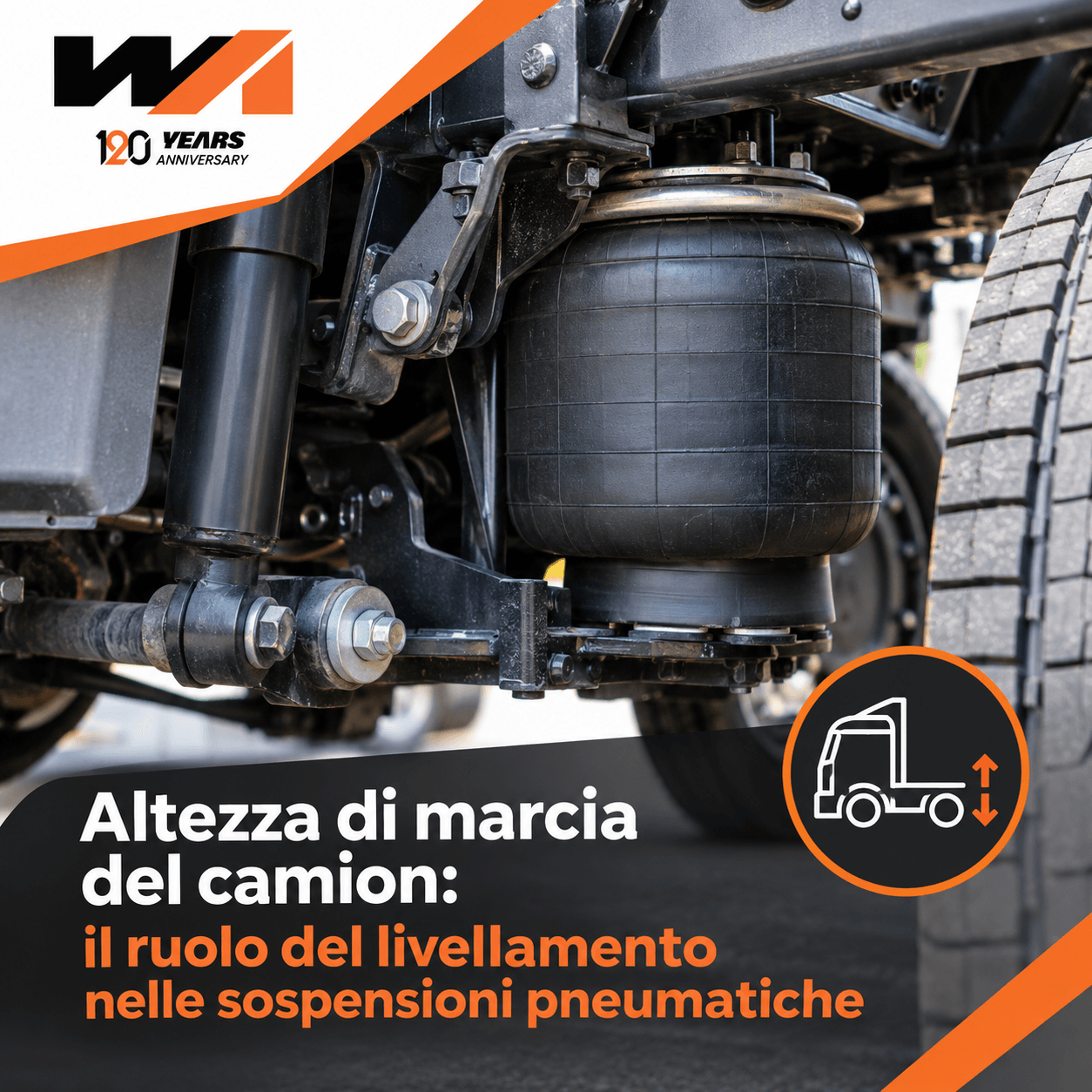
Truck Ride Height: The Role of Leveling in Air Suspension
The ride height of the truck is an important parameter for the correct functioning of the air suspension. Identifies the expected operating position between the frame and axle, according to references and conditions defined by the manufacturer. It does not simply coincide with the distance of the bodywork from the ground and cannot be assessed only by observing the vehicle from the outside.
Understanding the role of leveling helps workshops and fleet managers distinguish normal load adaptation from a condition that requires technical verification.
What is the ride height of the truck?
The ride height represents a reference height of the suspension in the configuration intended for circulation. The measuring points, nominal value and tolerances depend on the vehicle and the installed system.
There is therefore no universal size valid for all trucks. Even seemingly similar vehicles can use different axles, suspensions and configurations.
The verification must start from the relevant technical documentation. Measuring a distance without knowing the correct references can produce an unremarkable result or lead to improper adjustment.
How air suspension leveling works
When the load changes, the force that the air springs must support varies. The leveling system manages the entry or exhaust of air to bring the suspension back to the expected height.
In mechanical configurations, a leveling valve senses the relative position between chassis and axle via an articulated link. In electronic systems, height sensors transmit information to the control unit, which controls the solenoid valves.
Level control follows a specific logic: it should not be confused with the damping of oscillations, entrusted to shock absorbers. Leveling and damping perform different functions within the same suspension system.
Why the correct altitude matters
The operating position helps to maintain the suspension in the working range foreseen by the project. An incorrect measurement can change the available compression and extension travel and the working conditions of the components.
The consequences depend on the vehicle architecture. It is not correct to automatically attribute noise, vibration or abnormal wear to the height of the suspension alone.
Air springs, shock absorbers, connections, sensors, supports and conditions of the pneumatic circuit must be considered together. The evaluation must cover the entire system.
Ride height and loading positions: what are the differences?
Some vehicles allow you to temporarily raise or lower the chassis for operational needs, such as pulling up to a dock. These positions do not necessarily coincide with the one planned for the march.
How to return to normal level, automatisms and limitations vary according to the setup. Before setting off again, you must follow the manufacturer's instructions and check for any warnings on the instrument panel.
The presence of a lifting control does not allow you to freely choose the circulation height.
Which anomalies require inspection?
A different set-up than usual, difficulty in reaching the expected level or frequent corrections deserve further investigation. These signals do not, by themselves, identify the responsible component.
To document the problem it is useful to note down load conditions, present messages, time of appearance and recent interventions. The workshop will be able to check the height, leveling valve connections, sensors and circuit according to the applicable procedure.
Adjustments and calibrations must comply with specific values and instructions, without modifications based on visual impression alone.
Correctly identify the suspension components
When the need to replace a component arises, the application, reference number and vehicle configuration must be confirmed. The external appearance does not demonstrate compatibility.
To learn more about the Way Assauto range, consult the sections dedicated to shock absorbers e air springs. For a component inquiry, contact the team indicating vehicle data, assembly position and available references: complete information makes the technical comparison more precise and effective from the first contact with the contact person.
Leave a Reply