

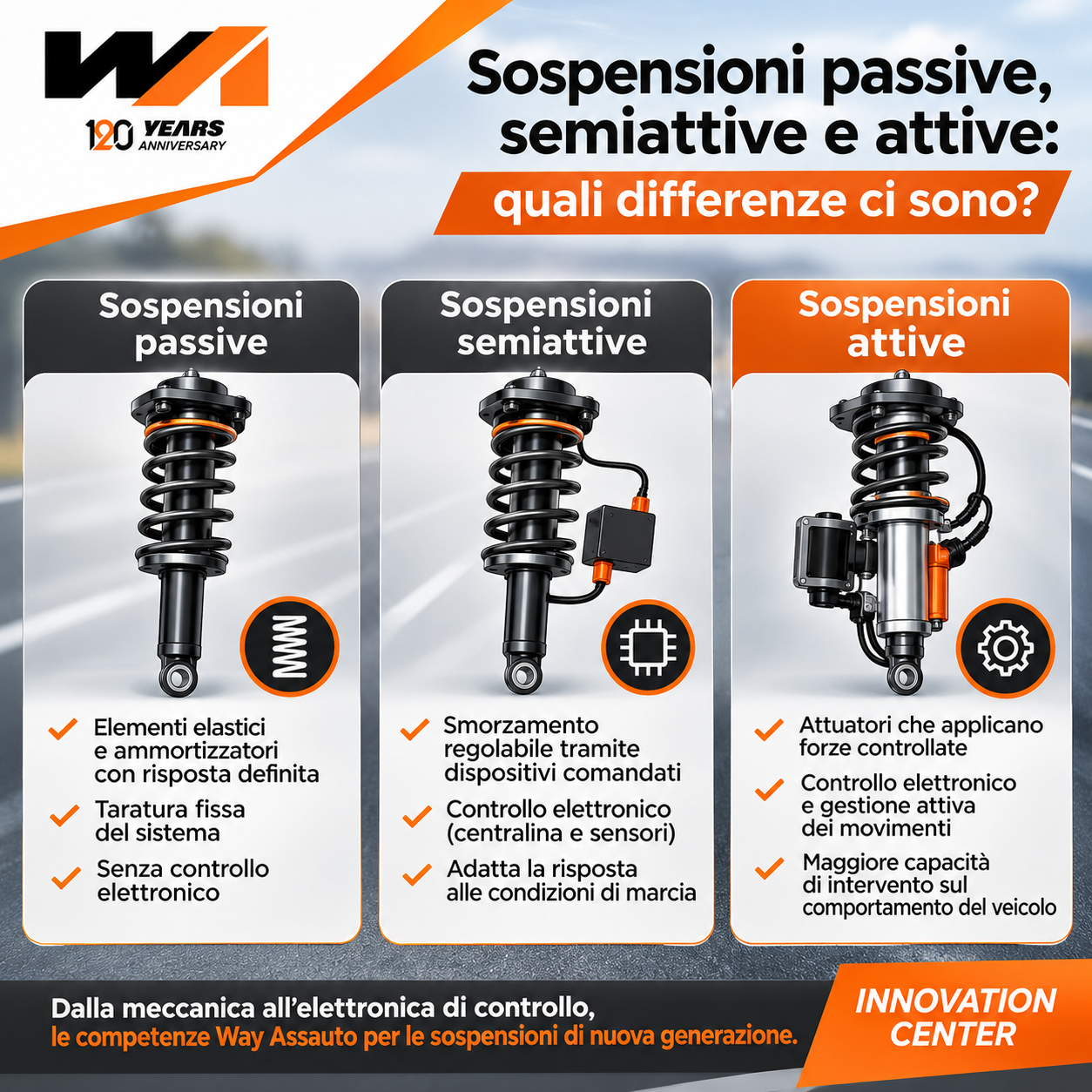
Passive, semi-active and active suspensions: what are the differences?
The passive, semi-active and active suspensions represent three different approaches to managing vehicle movements.
Although they share the goal of contributing to the control of dynamic behavior, they use different architectures and operating principles.
The distinction mainly concerns the way in which the elastic elements, damping and any forces applied through controlled devices are managed.
In the automotive and industrial vehicle sector, understanding these differences is important to evaluate a solution in relation to loads, operating conditions and design objectives.
The presence of sensors or electronic components is not sufficient, alone, to classify a suspension as active.
In this in-depth study, Way Assauto analyzes the characteristics of the three architectures and the main criteria to consider in the technical comparison.
How do passive suspensions work?
A passive suspension uses elastic elements and damping devices whose response is determined by the construction characteristics. Springs support the load and allow relative movement; shock absorbers dissipate energy, helping to control oscillations.
The response of the shock absorber can vary with rod speed, position and operating conditions, without requiring electronic control. Passive, therefore, does not necessarily mean simple or characterized by a constant force.
The calibration is developed to obtain a consistent compromise between comfort, movement control and application requirements.
What changes in semi-active suspensions?
Semi-active suspensions modify the damping characteristics through controlled devices. In systems with electronically controlled shock absorbers, a control unit processes the available signals and regulates the response of the component.
A common solution uses electronically controlled valves to modify the fluid passage. The system can thus adapt the damping to the detected conditions, within the limits set by the project.
The distinctive feature is that the device regulates the dissipation of energy associated with movement. It does not freely generate an actuating force like a fully active system.
The electrical power required for sensors, control unit and valves does not change this functional distinction.
How do active suspensions work?
Active suspensions employ actuators capable of applying controlled forces using external energy. The system can intervene on the vehicle's movements beyond just changing the resistance of the shock absorber.
Depending on the architecture, actuators can be hydraulic, electromechanical or based on other technologies. Sensors and algorithms define the necessary commands with respect to the set objectives.
This capability requires design integration that considers power supply, available power, thermal management and behavior in the event of an anomaly. Actual performance always depends on the specific implementation.
Are adaptive and air suspension the same thing?
The term adaptive suspension generally describes an ability to modify behavior, but is not sufficient to identify the architecture. It is necessary to check which parameters are regulated and through which components.
Even an air suspension is not automatically active. The presence of air springs or electronic height control does not demonstrate the existence of actuators dedicated to dynamic control.
Variable leveling and damping respond to different needs. They can coexist on the same vehicle, but must be described separately to understand the overall operation.
What criteria guide the choice?
The comparison must start from the conditions of use: mass, load variations, paths, operating speeds and movements to be controlled. Dimensions, maintenance, energy availability and integration with vehicle systems must also be considered.
Greater complexity is not automatically the best choice. Each solution must be evaluated against measurable requirements, through appropriate simulations and tests.
Even the comparison between results requires homogeneous conditions: a single curve or a commercial description do not demonstrate, by themselves, the superiority of an architecture.
From the application to the technical comparison with Way Assauto
To delve deeper into a suspension project, it is useful to share specifications, vehicle configuration and operating objectives. This information allows you to set up a dialogue on the real needs of the application.
Way Assauto presents in its own Innovation Center skills related to mechanics, mechatronics and control electronics. Consult the dedicated section e contact the team to delve deeper into relevant requirements, project scope and development possibilities.
Leave a Reply