

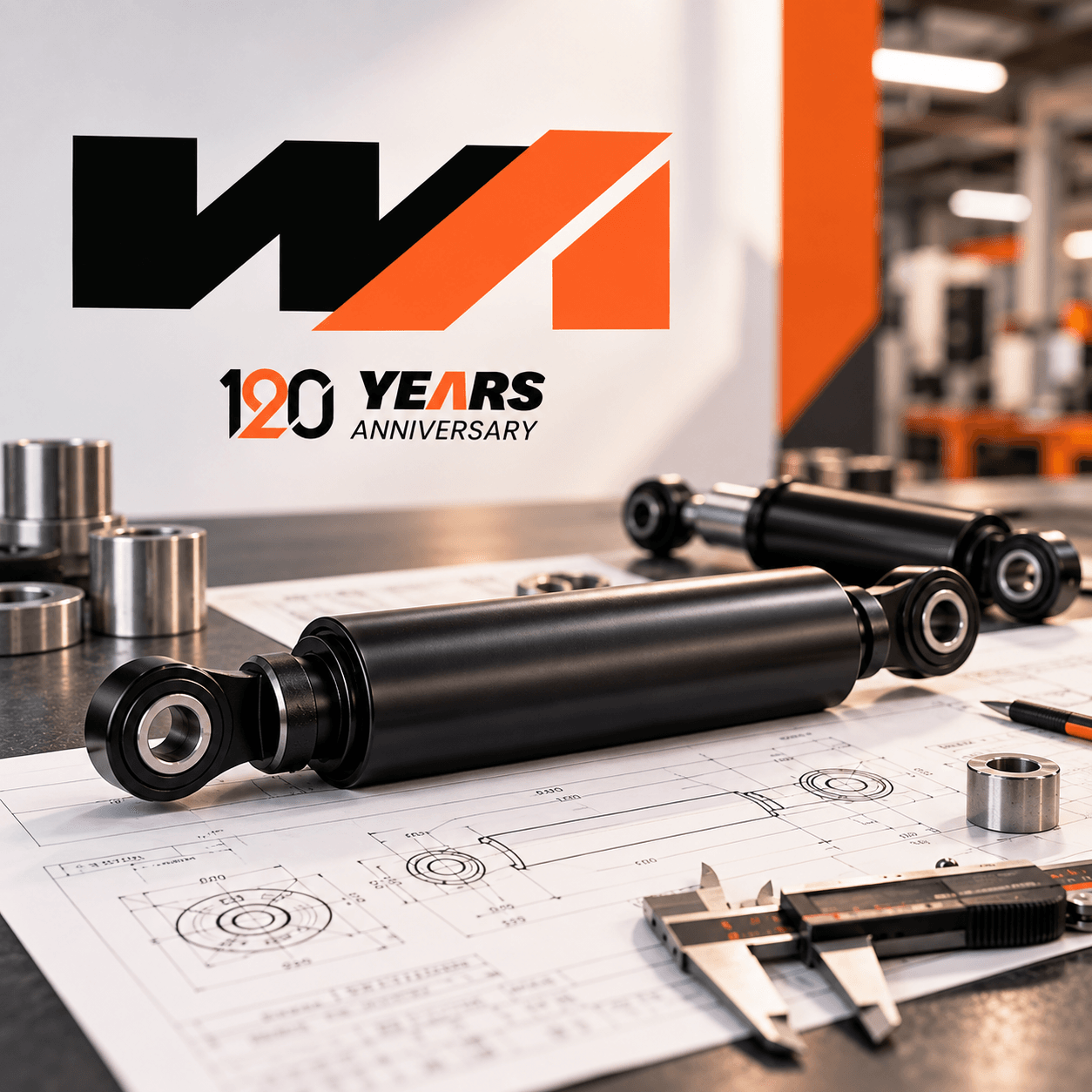
Special custom-made shock absorbers: when a catalog solution is not enough
The special custom-made shock absorbers they become a possibility to be evaluated when a standard solution fails to adequately satisfy the application requirements.
A shock absorber, in fact, does not work in isolation. It must fit within a precise system, respect the available dimensions, connect correctly to the structure and provide a damping response consistent with the movements it must control.
For this reason, choosing a component that is not in the catalog does not simply mean asking for it different sizes.
The starting point is another: understand the technical problem that the shock absorber must solve.
Which movement should it control? In what conditions will he have to work? What constraints prevent you from using an existing reference?
These are the questions from which the development of a dedicated solution can begin.
When are special custom-made shock absorbers needed?
Not every application requires designing a new component.
The first step should be to check whether an already available solution can meet the required technical requirements.
The development of special custom-made shock absorbers however, it becomes relevant when this verification highlights characteristics that an existing solution cannot adequately satisfy.
The problem may concern, for example:
- available dimensions;
- installation geometry;
- location of the attacks;
- travel required;
- type and direction of movement;
- required damping behavior;
- environmental conditions;
- operating conditions;
- application specific requirements.
It does not mean that each of these elements automatically requires a dedicated product.
They need to be analyzed Together, within the system in which the shock absorber will operate.
Why start from the application and not from the shock absorber?
This is one of the most important aspects.
When looking for a special solution, it may be natural to start from the existing component and ask for something seemingly similar:
“I need this shock absorber, but shorter.”
Or:
“I need the same ride, but with different attacks.”
Such a request provides some information, but may not be sufficient to understand the behavior required of the new component.
The shock absorber needs to be analyzed within the application.
Two externally similar components can in fact have different damping characteristics.
The same principle also emerges in the analysis of the force-velocity curve: size, shape and attachments are not sufficient to describe the dynamic behavior of a shock absorber. Wayass Auto
For this reason, the technical comparison should start from the function that the component must perform.
What information is needed to design a custom shock absorber?
A well-structured technical request allows you to understand the application more quickly.
It is not necessary for the customer to have all the data immediately.
However, it is useful to collect all the information already known.
An initial analysis may include:
- shock absorber function;
- system on which it will be installed;
- type of movement to be controlled;
- available dimensions;
- characteristic lengths;
- travel required;
- location and characteristics of the attacks;
- component orientation;
- environmental conditions;
- operating conditions;
- any available technical specifications;
- drawings, models or documentation of the application.
Depending on the project, additional parameters may be required.
This list should therefore not be interpreted as a universal technical data sheet: the data actually needed depends on the application.
Shock absorbers out of catalogue: because the dimensions are not enough
Let's imagine two shock absorbers with very similar external dimensions.
Same length, compatible stroke and apparently equivalent attachments.
This does not necessarily mean that they can be used in the same way.
The shock absorber must develop a response consistent with the movements of the system.
Therefore not only the geometric characteristics come into play, but also the dynamic behavior of the component.
This is one of the reasons why choosing a shock absorber should not be based solely on external appearance. Even apparently similar components can have different calibrations and damping curves. Wayass Auto
When developing a special component, geometric compatibility and functional behavior must therefore be considered together.
The damping response must be consistent with the system
There is no universally best calibration.
Increasing the damping force, for example, does not automatically mean obtaining a better performing component.
The goal is to achieve an adequate response to the application.
The force-velocity curve allows you to analyze the relationship between the speed of movement of the rod and the force developed by the shock absorber during compression and extension. Wayass Auto
During the development of special custom-made shock absorbers, the desired behavior must then be defined in relation to the system, operating conditions and project objectives.
From the technical requirement to the concept
Once the available information has been collected, the technical evaluation can begin.
The first objective is to understand whether it is really necessary to develop a new component.
If an existing solution can meet the requirements, dedicated engineering may not be necessary.
However, when the application requires specific characteristics, the process can continue towards the definition of the concept.
Way Assauto describes on its website a path that includes concept definition, detailed design, prototype development and tailor-made testing. Wayass Auto
It is a fundamental step: the customer requirement must be transformed into verifiable technical characteristics.
Special shock absorber design
After defining the objectives, the planning phase can begin.
The Way Assauto Innovation Center website describes research and design activities that include kinematic analyses, simulations and three-dimensional modeling. Wayass Auto
In this phase geometry and performance begin to be considered within the same project.
Aspects such as configuration, materials, interfaces with the system and required functional characteristics can therefore be evaluated.
Design is not just about making sure the component enter the available space.
It must lead to a solution consistent with the intended use.
From project to prototype
When the project requires the development of a dedicated solution, prototyping allows you to move from the model to the physical component.
This is where design assumptions can begin to be compared to actual behavior.
Way Assauto includes prototyping among the phases of its development process and, through the Innovation Center, indicates rapid prototyping activities, functional tests and validations. Wayass Auto
The prototype therefore does not necessarily represent the final point.
It can be a tool through which to collect data and verify the developed solution.
Testing and validation of customized shock absorbers
A special solution must be able to be verified against the objectives defined during the project.
The test methods naturally depend on the application and the agreed specifications.
Way Assauto describes prototyping and testing activities through test benches, vibration tests, road tests and comparative analyses. The company also indicates static, dynamic and duration controls and tests as part of its processes. Wayass Auto
Not all projects necessarily require the same sequence of tests.
It is therefore more correct to speak of a verification plan defined according to the application and project requirements.
A process that starts from the problem and arrives at the solution
The development of special custom-made shock absorbers can be summarized through a logical sequence:
application need → collection of requirements → verification of existing solutions → concept → design → prototype → testing and validation → possible industrialization.
We therefore do not start from the assumption that it is necessary to create something new.
Let's start with the problem.
Only after understanding the application is it possible to establish which technical path is most appropriate.
Special Way Assauto shock absorbers
Way Assauto also complements its product ranges special shock absorbers for industrial applications and declares the ability to design customized solutions in collaboration with customers. Wayass Auto
Experience in the design and production of damping systems allows us to start from the needs of the application to evaluate the technical solution.
If you are looking for a special custom-made shock absorber, the first step is to gather what you already know about the project.
Function, drawings, measurements, dimensions, connections, stroke, operating conditions and specifications available can form the basis for starting the comparison.
Don't have all the data yet?
The request can however start from the description of the application need.
Contact the Way Assauto team and submit your application for a technical evaluation.
Leave a Reply