

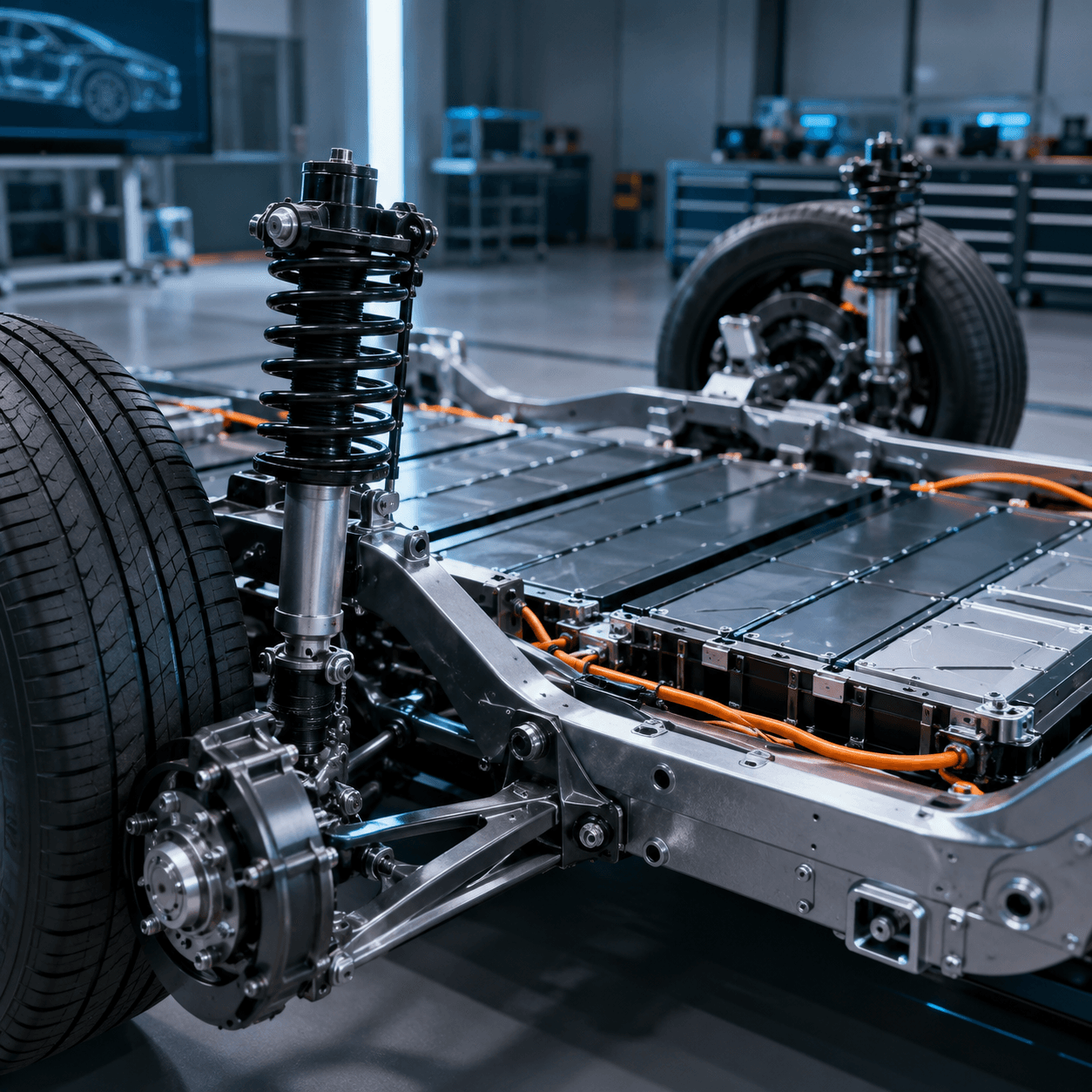
Suspensions for electric vehicles: what changes with the weight of the batteries?
Suspensions for electric vehicles must meet different needs than those of vehicles with combustion engines. One of the main reasons is the presence of the battery pack, a component that can significantly increase the overall mass of the vehicle and change its weight distribution.
The increase in mass does not only affect the ability of the springs to support the vehicle. It also affects the work of the shock absorbers, the response during cornering and braking, the comfort of the occupants and the stresses transmitted to the other components.
For this reason, electric vehicle suspensions must be designed and calibrated taking into account the specific characteristics of the platform, the positioning of the batteries and the expected conditions of use.
Why do batteries increase the weight of the electric vehicle?
The battery pack must store the energy necessary to power the engine and on-board systems. Capacity, required autonomy and cell technology can determine important differences in the overall mass.
In electric commercial vehicles, trucks and buses, the problem takes on even greater importance. In addition to the weight of the batteries, in fact, it is necessary to consider the load transported, the number of passengers or the equipment of the vehicle.
The suspensions must therefore manage:
- a potentially greater overall mass;
- different weight distributions;
- load variations;
- greater inertia in maneuvers;
- repeated stresses during service;
- comfort and stability needs.
It's not enough to make the suspension stiffer. A balance must be found between support, movement control and the ability to absorb road irregularities.
How does the suspension behavior change?
As the sprung mass increases, the energy that the shock absorbers must control during compression and rebound increases. After a pothole, braking or a change of direction, the body of the vehicle tends to continue its movement due to inertia.
Shock absorbers for electric vehicles must therefore be calibrated to limit:
- vertical oscillations;
- pitching during acceleration and braking;
- body roll when cornering;
- loss of stability;
- excessive bodywork movements;
- reduction in comfort.
Inadequate calibration can make the vehicle too rigid or excessively oscillating. In the first case the roughness is transmitted more to the occupants; in the second, precision and control are reduced.
Does the low center of gravity solve the problem?
In electric vehicles the battery pack is often placed at the bottom of the platform. This solution can lower the center of gravity and help reduce body roll compared to a higher positioned mass.
A low center of gravity is an advantage, but does not eliminate the effects of weight. The greater mass continues to influence inertia, the distances necessary to control movements and the work of the suspensions.
The design must therefore consider together:
- height of the center of gravity;
- overall mass;
- distribution between the axes;
- location of the battery pack;
- payload;
- tire characteristics;
- intended use of the vehicle.
Regenerative braking and shock absorbers
Electric vehicles generally use regenerative braking systems that recover energy during deceleration. The response may be more immediate and vary depending on the driving mode, regeneration level and system status.
The suspensions must correctly manage the load transfers generated by decelerations, limiting pitching and maintaining stable contact between the tires and the road.
This aspect is particularly important in electric industrial vehicles, where mass and load can change considerably between one condition of use and another.
Why does correct calibration also affect efficiency?
Efficient suspension helps keep the tires in smooth contact with the road and control oscillations. Unstable behavior or uneven tire wear can increase rolling resistance and negatively affect the efficiency of the vehicle.
The design of suspensions for electric vehicles must therefore seek a balance between:
- safety;
- comfort;
- stability;
- component life;
- load control;
- energy efficiency.
Active and semi-active suspensions for electric mobility
Active and semi-active suspensions can adapt the response of the shock absorbers to the driving conditions. Sensors and electronic systems detect parameters such as acceleration, body movement, steering and road irregularities.
The damping adjustment allows you to modify the behavior of the vehicle depending on the load and the situation, improving the compromise between comfort and control.
The Innovation Center Way Assauto develops solutions based on mechanics, mechatronics and control electronics, oriented towards the evolution of shock absorbers and suspensions for the mobility of the future.
To learn more about the possibilities of developing shock absorbers and suspension systems intended for new applications, you can contact the Way Assauto technical team.
Leave a Reply