

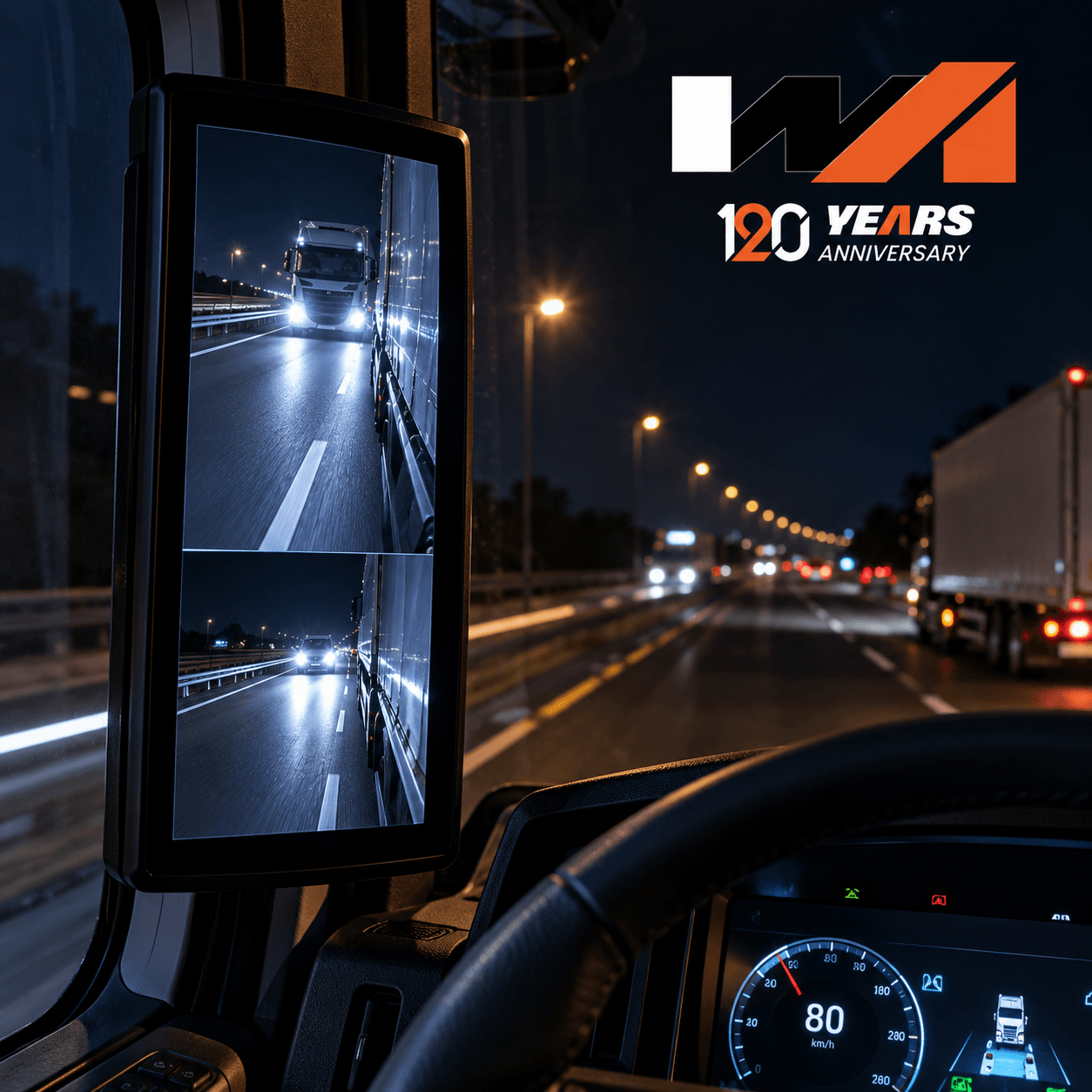
Glare and poor lighting: how a Mirror Cam works at night
A Mirror Cam at night has to deal with much more complex conditions than normal daytime driving. Dimly lit roads, headlights of following vehicles, rain, reflections and strong differences between light and dark areas can make it more difficult to control what happens to the sides and rear of a commercial vehicle.
A Mirror Cam system uses external cameras and monitors placed inside the cab to provide the driver with a representation of the areas filmed around the vehicle.
The quality of night vision, however, cannot be assessed by considering only the declared resolution.
Sensor, optics, image processing, ability to handle strong contrasts, display, latency and installation contribute together to the final result.
So let's see what happens when one Mirror Cam at night must work in real conditions.
How does a Mirror Cam work in low light conditions?
The cameras of a Mirror Cam system continuously acquire images of the external environment and transmit them to the monitors inside the cabin. As the light decreases, the system must be able to make visible details that an incorrectly processed image could lose in darker areas.
The camera then intervenes on various parameters, including:
- sensor sensitivity;
- exposure;
- brightness;
- contrast;
- digital noise reduction;
- management of light and dark areas;
- real-time image processing.
The goal is not to make the entire scene artificially bright, but to maintain a readable image without losing important information.
How is headlight glare managed?
One of the most frequent problems when driving at night is the glare caused by the headlights of vehicles following behind. In traditional mirrors, an intense light source can reflect directly towards the driver, disturbing vision.
A rearview camera for trucks instead, it must simultaneously manage very bright areas and poorly lit areas. The system can adjust exposure and contrast to limit overexposure generated by headlights and keep vehicles, roadways and other elements of the scene recognisable.
Performance depends on the quality of the sensor and how the software processes the images. Different systems may therefore offer different results even when they claim similar resolution.
Why is dynamic range important?
The dynamic range indicates the camera's ability to represent very light and very dark areas at the same time.
When driving at night, this feature becomes particularly important. The system may find itself resuming:
- high beams;
- unlit sections of road;
- entrances and exits from tunnels;
- urban areas with illuminated signs;
- yards with uneven lighting;
- vehicles approaching from behind.
Adequate dynamic range helps prevent headlights from appearing as large, featureless white areas or surrounding areas from becoming excessively dark.
Does the in-cab monitor affect visibility?
The quality of Mirror Cam at night It also depends on the monitor. A display that is too bright can tire the driver and create a source of distraction inside the cabin. An excessively dark monitor, on the other hand, can make it difficult to quickly see details.
It is therefore important that brightness, contrast and color rendering are suitable for driving conditions. The positioning of the display must also allow natural consultation, without forcing the driver to take his eyes off the road for a long time.
Reflections on the monitor surface can also affect readability. For this reason, anti-reflection characteristics and correct placement play an important role in visual comfort.
Can rain, dirt and condensation reduce image quality?
Night visibility can also be affected by the status of the camera. Water, dust, mud, salt or condensation on the lens can diffuse the light from the headlights and generate halos.
Before attributing a blurry image to an electronic problem, it is advisable to check:
- lens cleaning;
- presence of humidity or condensation;
- integrity of the medium;
- camera orientation;
- image stability;
- condition of connectors;
- correct display on the monitor.
Periodic maintenance is therefore essential to maintain the quality of vision over time.
Mirror Cam and blind spot monitoring at night
Areas close to a commercial vehicle can be difficult to control, especially during manoeuvres, lane changes and turns. The truck cameras they can widen the available field of vision and help the driver monitor certain areas to the side, rear or front.
The presence of a camera, however, does not eliminate the need for careful driving. The driver must know the system, correctly interpret the distances shown on the monitor and periodically check that the cameras and displays are working properly.
What to evaluate in a Mirror Cam for night driving?
Before choosing a Mirror Cam system it is useful to consider:
- image quality in real conditions;
- headlight and backlight management;
- readability of dark areas;
- stability of video transmission;
- image latency;
- quality and position of monitors;
- protection of cameras from atmospheric agents;
- ease of cleaning;
- compatibility with the vehicle;
- system compliance and documentation.
Resolution alone is not sufficient to evaluate night performance. You need to consider the entire system, from camera to monitor.
Mirror Cam Way Assauto solutions for industrial vehicles
Way Assauto offers systems Mirror Cam developed to improve visual control around industrial vehicles. Cameras and monitors work together to offer the driver usable images even in variable light conditions, contributing to blind spot monitoring and maneuver management.
At night, technology must face a specific challenge: to make what happens around the vehicle legible without transforming headlights, reflections and dark areas into disturbing elements. For this reason, choose one Mirror Cam per camion it means evaluating not only the definition of the image, but also the system's ability to adapt to real road conditions.
Leave a Reply