

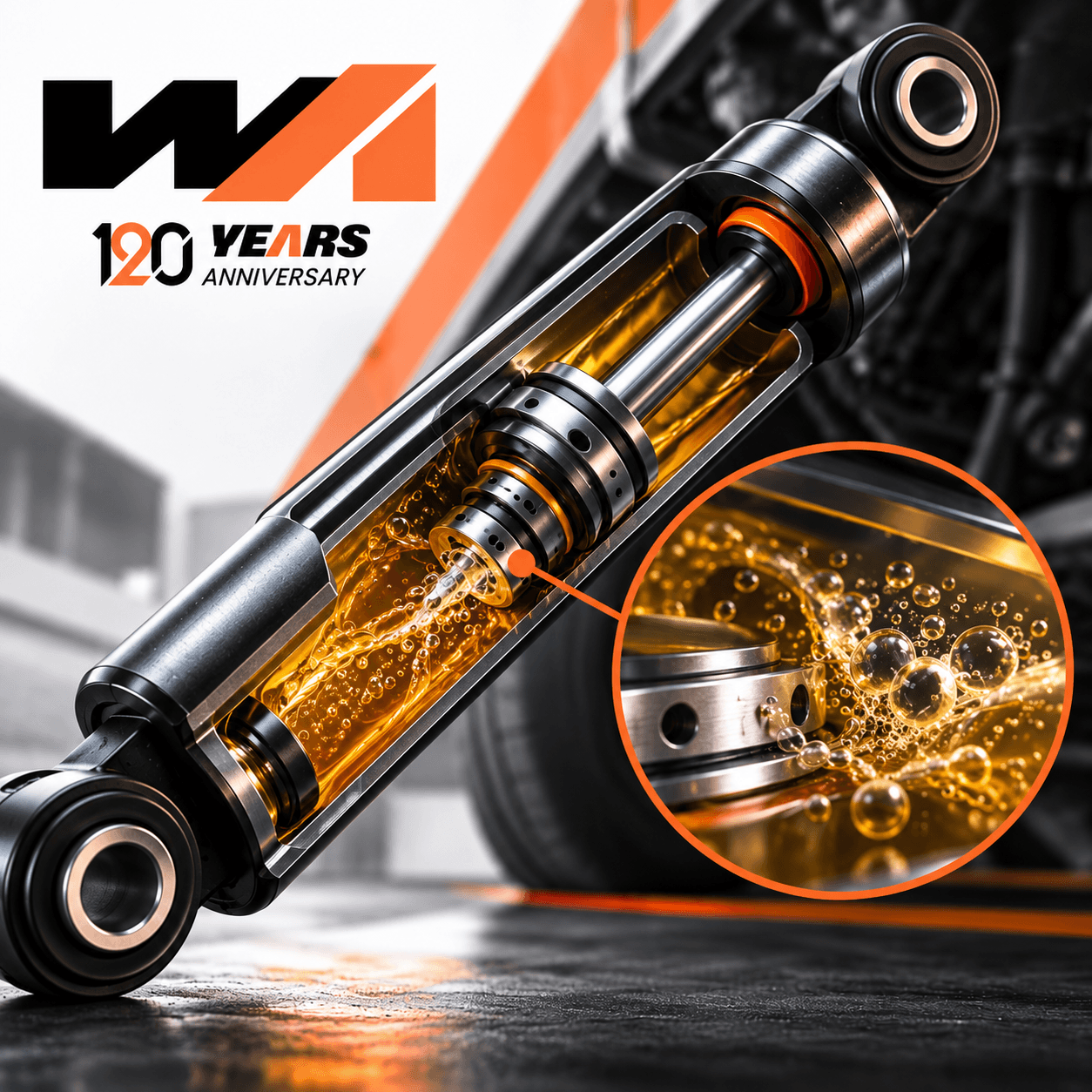
Cavitation in shock absorbers: what happens to the fluid
The cavitation in shock absorbers it is a phenomenon that can alter the behavior of the hydraulic fluid and make the response of the component less regular. It occurs inside the shock absorber and, for this very reason, cannot be recognized through simple external observation.
To understand its effects it is necessary to start from the functioning of the shock absorber. While driving, the piston moves inside the cylinder and forces the fluid to pass through calibrated valves and ducts. The resistance encountered by the oil generates the damping force necessary to control suspension oscillations.
When pressure conditions do not remain adequate, however, the behavior of the fluid can change.
What is cavitation in shock absorbers?
Cavitation occurs when, in a certain area of the shock absorber, the pressure of the fluid is reduced to the point of favoring the formation of vapor cavities.
These cavities are not normal air bubbles coming from the outside. They form in the fluid following particular pressure conditions and can collapse when they reach areas where the pressure becomes higher again.
The phenomenon can occur during rapid piston movements, intense stresses or working conditions in which the fluid cannot maintain a uniform response.
Cavitation in shock absorbers: what happens to the fluid?
Il shock absorber hydraulic fluid it should pass through the valves in a controlled manner, generating a force consistent with the intended calibration. The presence of cavities temporarily modifies the continuity of the fluid and can make the passage through the internal system less stable.
As a result, the damping force may become less smooth. The shock absorber may not always respond in the same way to apparently similar movements, especially when working at high rod speeds or subjected to repeated cycles.
Cavitation must therefore not be interpreted as a simple oil leak: it concerns the dynamic behavior of the fluid inside the component.
Are cavitation and aeration the same thing?
Cavitation and aeration can produce similar consequences, but they have different origins.
The cavitation depends on the local reduction of pressure and the consequent formation of vapor cavities. Aeration, on the other hand, occurs when air mixes with the fluid, generating foam or small bubbles.
In both cases, the fluid can become more compressible and the shock response less constant. To determine which phenomenon is occurring, however, it is necessary to analyze the component and its operating conditions.
What factors can promote cavitation?
The factors that can influence the phenomenon include:
- piston movement speed;
- changes in internal pressure;
- characteristics of the fluid;
- operating temperature;
- valve configuration;
- frequency and intensity of stress;
- conditions of use of the vehicle;
- internal design of the shock absorber.
In industrial vehicles, high loads, demanding journeys and irregular surfaces can subject the suspensions to particularly severe work cycles. This makes it essential to develop each shock absorber according to the application for which it is intended.
How is the behavior of the shock absorber verified?
Cavitation cannot be diagnosed with certainty based solely on driving sensations. An irregular response can in fact also depend on wear, temperature, ventilation, valves, bushings or other suspension components.
To evaluate the behavior of the shock absorber, controlled tests are necessary, during which parameters such as force, rod speed, temperature, pressure and response repeatability are analysed.
Bench tests allow you to compare the behavior of the component in different conditions and verify that the damping force remains consistent with the expected specifications.
Design, fluid and performance control
Limiting the risk of cavitation requires a correct balance between internal architecture, valves, pressure, fluid and operating conditions. Each element must be designed to work together with the others.
Way Assauto develops and tests shock absorbers for industrial vehicles, buses, trailers, railway applications and special uses. Through design, prototyping and laboratory tests, the company analyzes the behavior of the components in the conditions foreseen by the application.
Understanding the cavitation in shock absorbers it means going beyond the external appearance of the product and observing what happens inside: it is precisely in the control of the fluid and the dynamic response that a fundamental part of the shock absorber's performance is determined.
Leave a Reply