

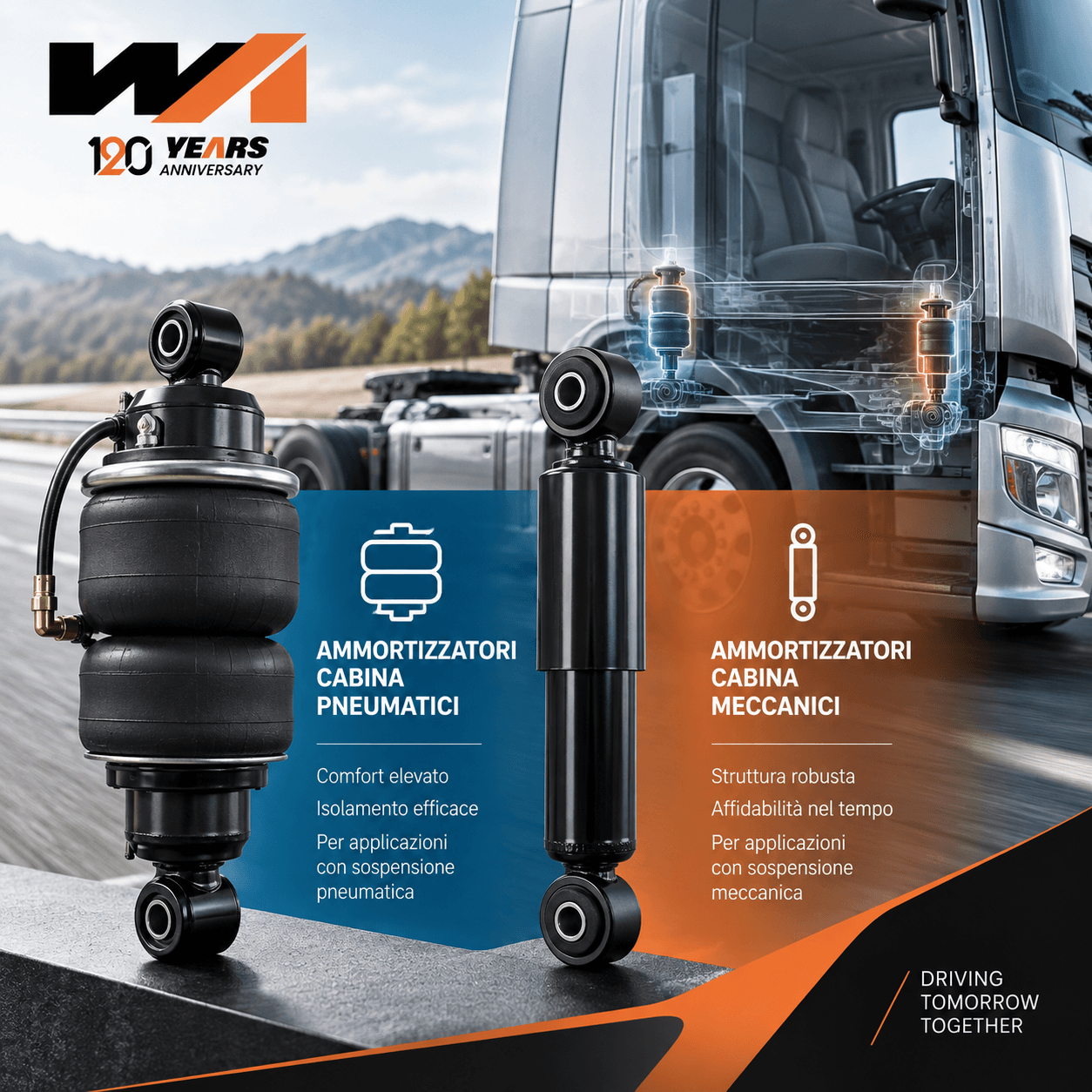
Pneumatic or mechanical cabin shock absorbers: differences and applications
The pneumatic or mechanical cabin shock absorbers they are used on industrial vehicles to control the movements of the cab in relation to the chassis and help reduce oscillations and vibrations perceived by the driver while driving.
Potholes, irregularities in the asphalt and changes in structure continually subject the cabin to stress. The suspension system must therefore isolate, support and control these movements to ensure smooth behavior.
However, the pneumatic and mechanical configurations are not automatically interchangeable. Structure, connections and operating characteristics depend on the vehicle and the system envisaged by the manufacturer.
For this reason, before choosing a spare part, it is essential to correctly identify the application.
How truck cab suspension works
The cabin of an industrial vehicle is connected to the chassis through a system designed to limit the transmission of stresses coming from the road.
The elastic elements manage part of the irregularities, while the shock absorbers control the speed of the compression and extension movements.
Without adequate damping, in fact, the cabin would tend to continue to oscillate after a load.
The correct functioning of the entire system therefore contributes to the driver's comfort and the control of cab movements.
Depending on the configuration envisaged by the vehicle, different solutions can be used, including systems with pneumatic or mechanical cabin shock absorbers.
How mechanical cabin shock absorbers work
In a mechanical configuration, the shock absorber works together with the elastic elements provided by the cab suspension system.
Movement is controlled through the shock absorber's internal hydraulic system, which generates a calibrated damping force during the compression and rebound phases.
This configuration does not require the shock absorber to be integrated with a pneumatic element.
However, correct functioning depends on several factors:
- shock absorber calibration;
- conditions of the stem and seals;
- integrity of the bushings;
- media status;
- compatibility with the vehicle;
- correct installation.
A mechanical cab damper should therefore not be identified solely by its shape and size.
Two externally similar components can in fact have different connections, operating dimensions or damping characteristics.
How pneumatic cabin shock absorbers work
In pneumatic systems, compressed air is used as part of the elastic system intended to support and isolate the cabin.
Depending on the configuration, the pneumatic element and hydraulic shock absorber can be integrated into the same assembly or work as separate components.
It is therefore important to distinguish the two functions: the pneumatic element supports and contributes to the insulation of the cabin, while the shock absorber controls the oscillations.
The presence of compressed air therefore does not eliminate the need for damping.
In the event of anomalous behavior of the cabin, the diagnosis may require checking not only the shock absorber, but also the other elements that make up the system.
These may include, depending on the application:
- pneumatic element;
- piping;
- fittings;
- supports;
- bushings;
- connections;
- other components of the pneumatic circuit.
A leak or anomaly in the system can in fact change the behavior of the cab suspension.
Pneumatic or mechanical cabin shock absorbers: what are the differences?
The main difference concerns the configuration through which the cabin is supported and isolated.
In mechanical systems, the elastic elements foreseen by the specific vehicle configuration are used. In pneumatic systems, however, an element that uses compressed air also intervenes.
They can therefore change:
- group structure;
- typology of attacks;
- presence of fittings and pneumatic connections;
- associated components;
- installation procedures;
- elements to check during diagnosis;
- specific characteristics of the spare part.
It is not correct to establish absolutely which solution is better.
The component must be consistent with the system designed for that specific vehicle. For this reason the choice must always start from the identification of the application.
Are pneumatic and mechanical shock absorbers interchangeable?
In general, they should not be automatically considered interchangeable.
The cab suspension is designed as a system in which different components work together according to certain geometric and functional characteristics.
Replacing a component solely because it has apparently similar dimensions can therefore lead to the choice of an incorrect spare part.
It is necessary to always check the correspondence with the application and the expected specifications.
How to identify the correct cab shock absorber
To choose correctly between pneumatic or mechanical cabin shock absorbers it is necessary to start from the vehicle data and the installed component.
The elements useful for identification may include:
- OE code;
- vehicle make;
- model;
- year and version;
- mounting position;
- expected operational dimensions;
- typology of attacks;
- characteristics of the bushings;
- any pneumatic connections;
- codes and references shown on the component.
Il OE code represents one of the most useful references to trace the correct application.
Shape and external dimensions alone are not sufficient: two apparently similar shock absorbers can be designed for different vehicles or operating conditions.
When to check the cab shock absorbers
Abnormal movements of the cabin should not be automatically attributed to the shock absorber.
However, some signs may suggest the need to check the system:
- excessive oscillations;
- abnormal vibrations;
- noises coming from the cabin supports;
- irregular movements;
- visible leaks;
- deterioration of bushings or supports;
- cabin behavior different from normal.
Vibrations can in fact have different origins, including suspensions, cab supports, tires and other vehicle components. Way Assauto has already explored this aspect in its technical contents.
For this reason, a correct diagnosis should consider the system as a whole.
Way Assauto cab shock absorbers for industrial vehicles
Way Assauto includes in its range solutions dedicated to the cab suspension of industrial vehicles, with pneumatic and mechanical cabin shock absorbers. Both types are present in the product range published on the official website.
The company also operates in the sector of shock absorbers for trucks, trailers, buses, automotive and railway applications, combining production with design, development, testing and control activities.
Correctly identifying the spare part means choosing a component consistent with the system provided by the vehicle and with the related technical characteristics.
To identify the correct solution it is therefore appropriate to compare OE code, application and characteristics of the component.
Leave a Reply