

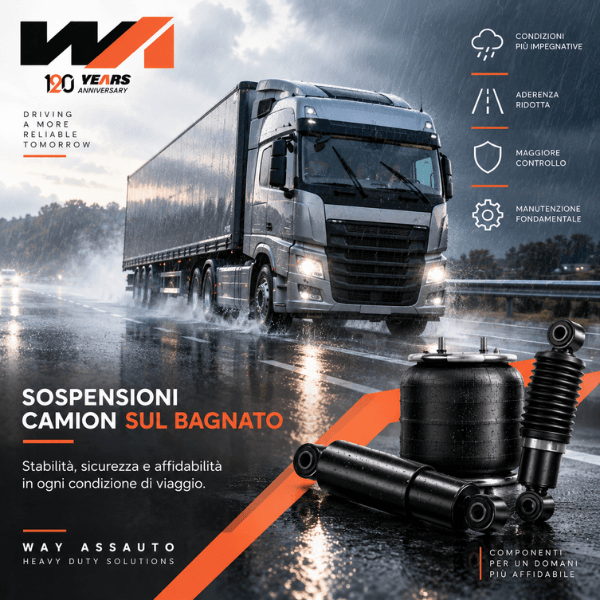
Rain, wet asphalt and suspensions: what changes for a truck
The truck suspension in the wet they contribute to the control of the vehicle in a condition in which the available grip between the tires and the road may decrease. In fact, rain and water on the asphalt modify the behavior of the vehicle, especially during braking, curves and sudden changes in the trajectory.
On trucks and industrial vehicles, mass, load distribution and vehicle dimensions also come into play. Tires, brakes, suspension and shock absorbers must therefore work correctly as part of a single system.
Let's see what changes with wet asphalt and why the state of the suspension can become even more important when road conditions worsen.
How driving a truck changes on wet asphalt
The presence of water on the road generally reduces the grip available between the tire and the asphalt. This can affect braking, steering and the vehicle's ability to maintain its trajectory.
When driving in the wet the following may increase:
- the space needed to slow down;
- the risk of loss of adhesion;
- vehicle oscillations;
- load movements;
- sensitivity to surface irregularities;
- difficulties in sudden maneuvers.
The result depends on numerous factors, including speed, tire condition, amount of water present, load weight, road characteristics and suspension status. It is therefore not possible to establish identical behavior for each truck.
Truck suspensions in the wet: why they are important
The role of shock absorbers in the wet
The shock absorbers have the task of controlling the movements of the suspensions and limiting the oscillations of the bodywork and chassis. When they work properly, they help the wheel maintain smoother contact with the road surface.
In the wet this aspect becomes particularly important. An inefficient shock absorber can allow excessive oscillations after a pothole, a depression or a change in the road surface. In these conditions the pressure exerted by the tire on the asphalt can become less uniform, influencing the stability of the vehicle.
A worn shock absorber is not necessarily the sole cause of a loss of control or inefficient braking. However, it can contribute to making the truck more difficult to handle when grip is already reduced.
Pneumatic suspension and air springs
Many trucks, trailers and semi-trailers use air suspension systems with air springs. These components support the load and help maintain the vehicle's stability.
During checks it is important to check:
- any air leaks;
- cracks or abrasions on the surface;
- deformations;
- uneven vehicle height;
- condition of valves and connections;
- presence of moisture or contaminants in the system.
An anomaly in the pneumatic suspension can change the height of the vehicle and the load distribution. In the wet, an incorrect set-up can make the truck's response less stable when cornering or braking.
Tires, brakes and suspension work together
To handle wet driving safely, it is not enough to check just one component. Worn tires, incorrect air pressure, inefficient brakes or worn suspension can all affect each other.
It is therefore appropriate to check:
- tread depth and wear;
- tire pressure;
- shock absorbers;
- air springs;
- bushes and fixing points;
- braking system;
- correct vehicle alignment.
Uneven tire wear, noises, vibrations or persistent oscillations may indicate the need for a professional inspection.
Check your suspension before the rainy season
Preventive maintenance allows you to identify any anomalies before the truck is used in more demanding conditions. The check should consider the entire suspension system and not just the individual shock absorber.
Way Assauto develops shock absorbers and components for trucks, buses, trailers and industrial vehicles. It is possible to locate the correct spare part or receive technical support contact Way Assauto indicating the vehicle model, the application and the OE code of the component.
Leave a Reply