Railway primary and secondary suspension: which component works in each system
The primary and secondary railway suspension plays a fundamental role in controlling vehicle movements, stability and comfort while driving. In railway vehicles, in fact, the suspension system can be organized on two levels that work at different points between the wheels, trolley and body.
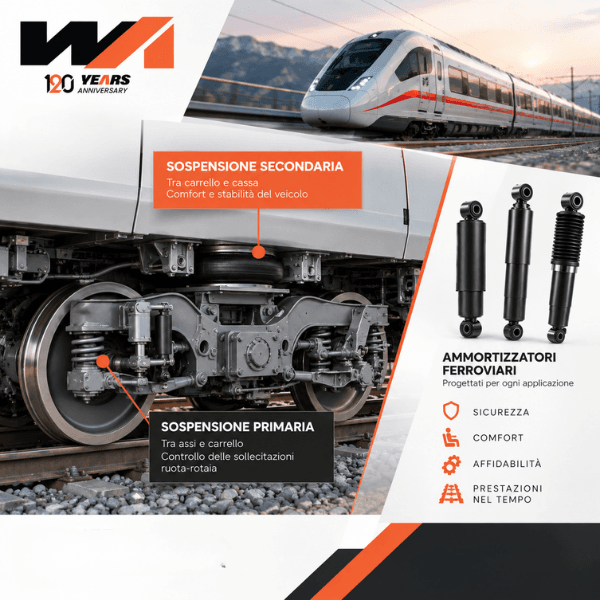
The primary suspension operates in the area closest to the axles and the wheel-rail contact. The secondary one instead acts between the trolley and the body of the vehicle. This distinction determines different functions and characteristics also for the shock absorbers installed.
Let's see how the two systems work and which components can be used in the different railway configurations.
What is primary railway suspension
Primary suspension is the system that directly connects the rail bogie, or bogie, to the axles and axleboxes. It is therefore located in the part closest to the contact between the wheel and the rail.
Its main task is to absorb and control the stresses generated by wheel-rail contact and track irregularities. The primary suspension helps reduce vibrations transmitted to the truck and protects the mechanical components from the most immediate stresses.
Among the main components of the primary railway suspension there may be:
- coil springs;
- elastomeric elements;
- rubber springs;
- pneumatic suspension, in some configurations;
- bushings and supports;
- vertical shock absorbers;
- shock absorbers dedicated to movement control.
Primary suspension shock absorbers work primarily to control relative movements between the axles, bushings, and chassis of the truck. Their function is to limit oscillations and vibrations that could compromise the stability of the system or accelerate the wear of the components.
What is railway secondary suspension
The secondary suspension is located between the bogie and the body of the rail vehicle. It is therefore the system that helps to isolate the passenger compartment and the structure of the train from the stresses coming from the bogie.
This suspension plays a particularly important role in passenger comfort and chassis stability. It must manage the vertical, lateral and longitudinal movements that occur while driving, cornering, accelerating and braking.
Secondary suspension components may include:
- air springs;
- coil springs;
- elastomeric elements;
- vertical shock absorbers;
- lateral shock absorbers;
- longitudinal shock absorbers;
- anti-snaking shock absorbers or Yaw Damper.
Anti-snaking dampers generally connect the body to the landing gear and control yaw movements. Their task is to limit the lateral oscillations and rotational movements of the trolley, contributing to the stability of the train especially at higher speeds.
Which component works in each system?
The distinction does not only concern the name of the component, but above all the position and the function it performs.
In the primary suspension, the elements installed between the axles, bushings and undercarriage mainly work. These components absorb the stresses coming directly from the rail and help control the movements of the wheel-cart assembly.
In the secondary suspension, however, the components positioned between the trolley and the body work. The springs support the weight of the body, while the shock absorbers control oscillations, vibrations and relative movements between the undercarriage and the vehicle structure.
There is therefore no universally interchangeable component between primary and secondary suspension. Each railway shock absorber must be designed based on location, function, load, speed, excursion and conditions of use.
Because design and testing are fundamental
Railway shock absorbers must maintain constant performance even during extended duty cycles and under complex operating conditions. For this reason, the design must be accompanied by dimensional checks, functional tests, durability tests and checks of the damping characteristics.
Way Assauto develops solutions for railway applications and suspension systems intended for different configurations of rolling stock. Experience in design and testing allows us to identify the most suitable component in relation to the specific needs of the vehicle.
To receive information on railway shock absorbers, primary or secondary suspensions and anti-snaking solutions, it is possible contact Way Assauto technical support indicating application, mounting position and system characteristics.
Leave a Reply