

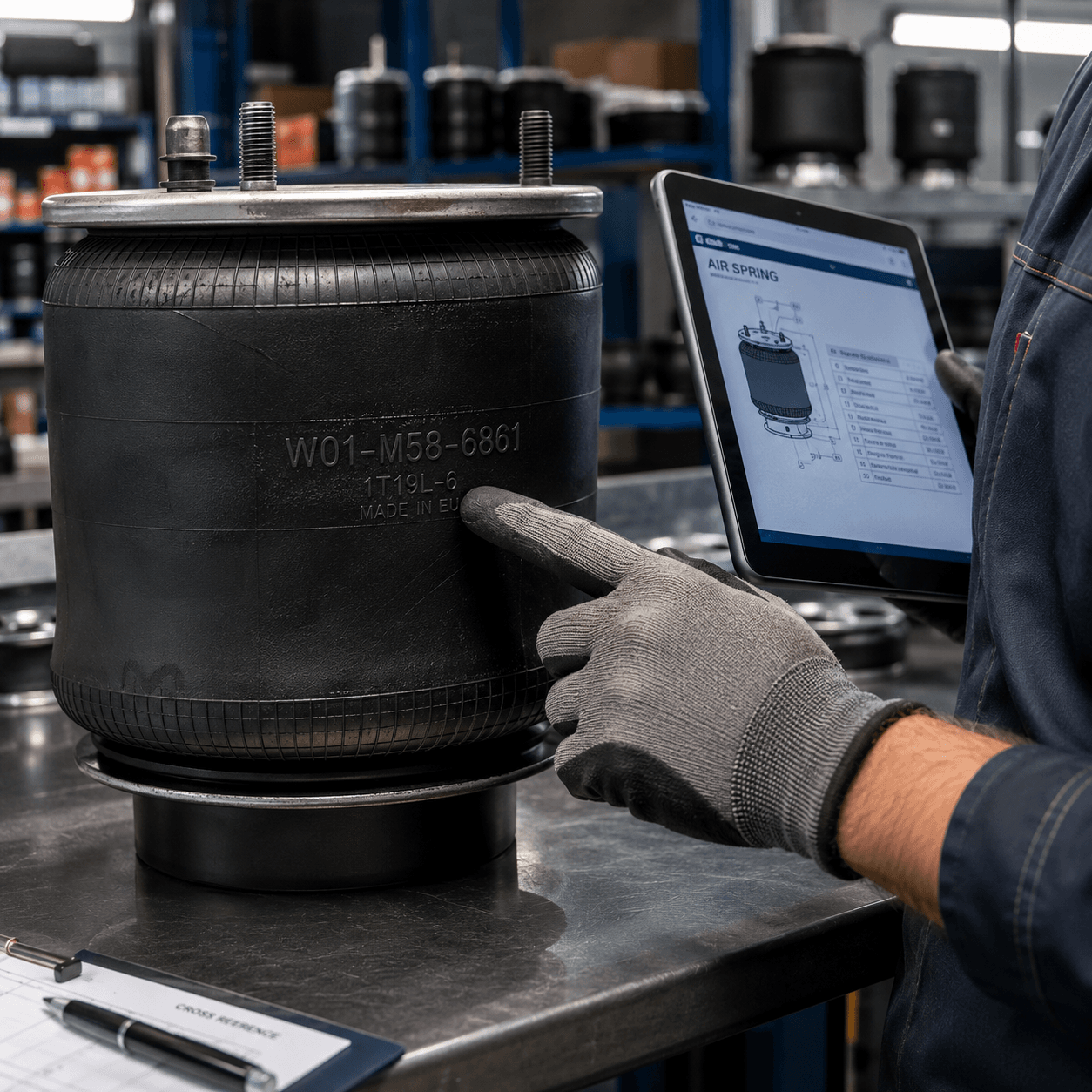
How to identify an air spring starting from the code
Correctly identifying an air spring starting from the code is essential to avoid mistakes when choosing the spare part. In the pneumatic suspension systems of trucks, buses and trailers, components can be used that are very similar in appearance, but different in size, connections, load capacity and configuration.
Searching by code allows you to find the compatible air spring more quickly. The code, however, should not be the only element taken into consideration: before assembly it is always necessary to compare the technical characteristics of the spare part with those required by the application.
Where is the air spring code located?
The air spring code can be printed, engraved or shown on a label applied to the component. Depending on the manufacturer and the type of product, you may find:
- on the rubber bellows;
- on the top plate;
- on the lower piston;
- on an identification label;
- on the original packaging;
- in the technical documentation of the vehicle;
- on the invoice or on the previous spare part order.
Before reading the code it may be necessary to carefully clean the surface, removing dust and dirt without using tools or products that could damage the rubber.
If some characters are not legible, it is useful to photograph the component from multiple angles and note all sequences that are still visible.
OEM code and manufacturer code: what are the differences?
Multiple references can appear on the same air spring. The OEM code generally identifies the reference associated with the vehicle manufacturer or original equipment application. The component manufacturer can instead use its own commercial code.
The main references can therefore include:
- manufacturer's OEM code;
- spring manufacturer code;
- codice aftermarket;
- serial number;
- reference of the establishment;
- production-related markings.
Not all the sequences present on the component allow the spare part to be identified. Batch, date or production numbers should not be confused with the product code.
For this reason it is important to verify the reference through a catalog or a reliable cross reference system.
How to use the code to find the spare part?
Once you have identified the air spring code, you can search for the correspondence in the manufacturer's or supplier's catalogue. The cross reference system allows you to connect an original reference to a compatible aftermarket product.
The procedure should include:
- complete transcription of the code;
- checking letters, numbers, spaces and hyphens;
- search for the reference in the catalogue;
- vehicle and application control;
- comparison of technical characteristics;
- confirmation of mounting position;
- final check before installation.
Just one incorrect figure can lead to a different component. It is therefore advisable not to arbitrarily reconstruct the missing characters.
Why might the code not be enough?
A code may have been replaced, updated, or associated with multiple applications. Furthermore, a spare part that does not correspond to the original configuration may have previously been installed on the vehicle.
In addition to the air spring code, it is advisable to provide:
- vehicle make and model;
- year or series of production;
- chassis number, when necessary;
- axis and mounting position;
- type of suspension;
- original component code;
- photographs of the installed spring;
- main measures.
This information helps distinguish apparently identical components and reduce the risk of incompatibility.
What technical characteristics should be compared?
Before confirming your choice it is necessary to check the physical configuration of the air spring. The most important elements include:
- bellows diameter;
- minimum and maximum height expected;
- piston shape and dimensions;
- top plate;
- number and location of prisoners;
- lower attacks;
- position and size of the air inlet;
- any connections;
- distance between fixing points.
It should also be checked whether the required spare part is a complete air spring or just the bellows. Two products belonging to the same family can in fact differ due to the presence of piston, plates or other elements.
What to do if the code is not readable?
When the code is erased or the component is very damaged, identification can be made by collecting the information available on the vehicle and comparing the characteristics of the spring.
It is useful to prepare:
- full photos;
- close-up images of the attacks;
- component measurements;
- location on the vehicle;
- code of the spring mounted on the opposite side;
- identification data of the truck, bus or trailer.
The component mounted on the other side can provide a reference, but must be verified before using it as the basis for the order.
Identify an air spring with Way Assauto
Correct identification of an air spring allows you to avoid assembly errors, delays and vehicle downtime. Code, application and construction features must always be checked together.
Way Assauto provides air springs for trucks, buses, trailers and industrial vehicles, supporting spare parts dealers and distributors in verifying references.
To identify the compatible air spring, you can send the available code, vehicle data and photographs of the component to be replaced to the Way Assauto team.
Leave a Reply