

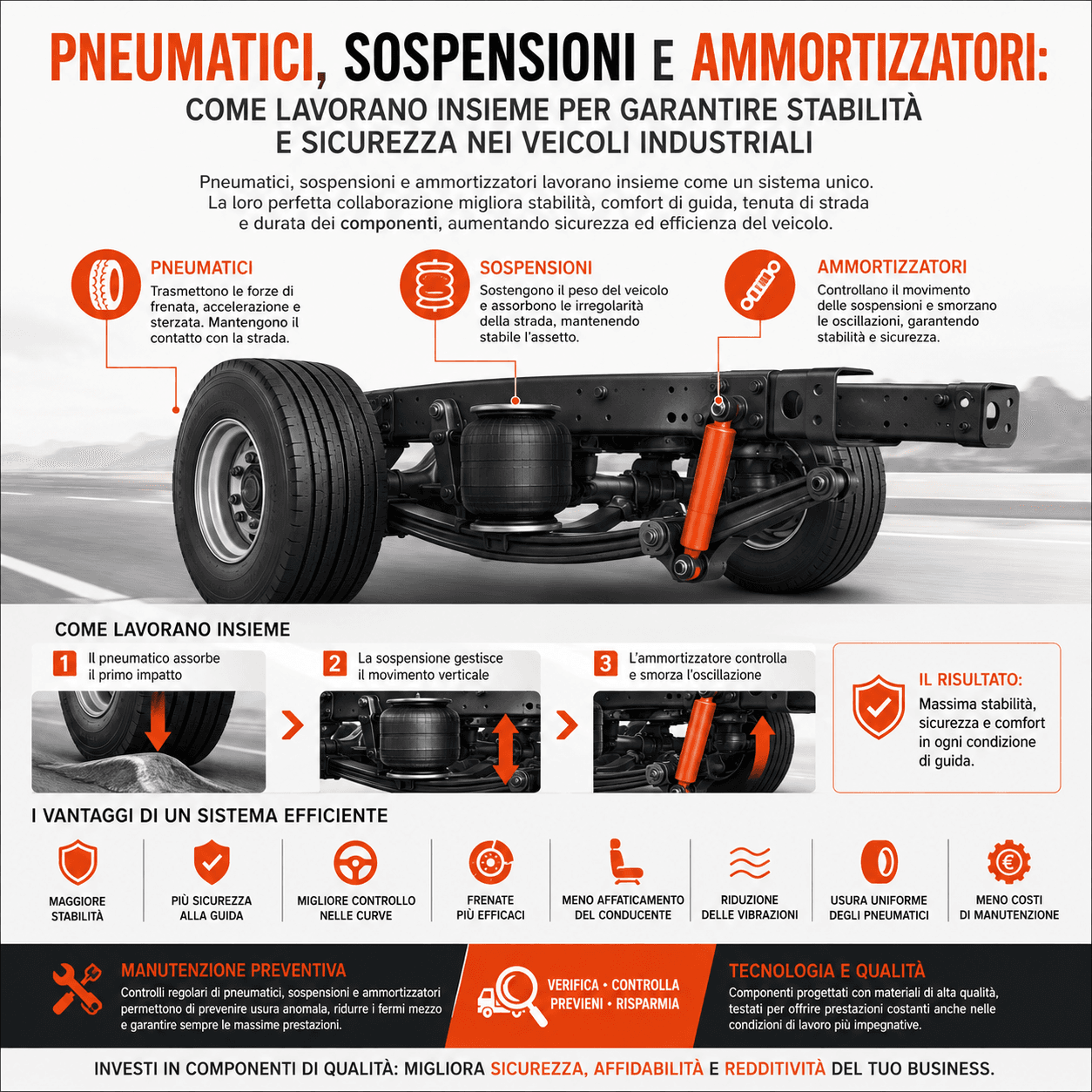
Tyres, suspensions and shock absorbers: how they work together to ensure stability and safety in industrial vehicles
When it comes to the safety of industrial vehicles, attention is often focused on the engine, the braking system or the electronic driver assistance systems. However, there is a fundamental mechanical balance that allows a truck, bus or trailer to tackle every kilometer in complete safety: the perfect collaboration between tires, suspensions and shock absorbers.
These three elements never work separately. On the contrary, they constitute a single dynamic system that directly influences the stability of the vehicle, driving comfort, road holding and the life of numerous mechanical components.
Tires in industrial vehicles: the first safety element
I truck tires they represent the only point of contact between the vehicle and the road surface. They are designed to support high loads, ensure grip and effectively transfer acceleration, braking and steering forces.
In order for them to work correctly, however, it is essential that they always remain in contact with the ground. And this is precisely where suspensions and shock absorbers come into play.
Even the best tire loses effectiveness if the suspension system is unable to maintain constant contact with the asphalt.
Industrial vehicle suspensions: function and advantages
The industrial vehicle suspensions they have the task of supporting the weight of the vehicle and absorbing irregularities in the road.
Every bump, hole or difference in height generates forces that must be managed to avoid excessive stress on the chassis, cab and transported load.
Suspensions contribute to:
- correctly distribute the weight of the vehicle;
- keep the buoyancy stable;
- improve driver comfort;
- reduce vibrations;
- protect the cargo during transportation.
Alone, however, they are not enough.
Shock absorbers for industrial vehicles: why they are indispensable?
The truck shock absorbers They have the task of controlling the movement of the suspensions.
Whenever a suspension compresses or extends, it naturally tends to continue to oscillate. The shock absorber intervenes precisely to dampen these oscillations, quickly bringing the vehicle back to equilibrium conditions.
Without correct damping the following can occur:
- loss of adhesion;
- longer braking distance;
- uneven tire wear;
- reduction of stability;
- increased vibration;
- less steering precision.
How do these three components work together?
The correct functioning of a suspension system it depends on the continuous collaboration between tires, suspension and shock absorbers.
When the truck hits a pothole:
- the tire absorbs the first impact;
- the suspension handles vertical movement;
- the shock absorber controls and dampens the oscillation.
This process happens in a few moments and is repeated thousands of times during each journey.
If just one of these components does not work properly, the others are also put under greater stress, compromising the performance of the entire vehicle.
What happens when one of the components is worn out?
The wear of just one of the elements can generate numerous problems.
An inefficient shock absorber can cause abnormal tire wear.
Worn tires can reduce the effectiveness of the suspension.
A damaged suspension can increase the stresses transmitted to the shock absorbers.
For this reason it is essential to consider the system as a whole, avoiding intervening exclusively on the apparently defective component.
The advantages of an efficient suspension system
A system composed of tires, suspension and shock absorbers in perfect working order offers numerous benefits:
- better vehicle stability;
- greater safety while driving;
- better control in turns;
- more effective braking;
- less driver fatigue;
- vibration reduction;
- greater protection of transported goods;
- more uniform tire wear;
- reduction in maintenance costs.
For fleets and transport companies, these aspects translate into greater operational efficiency and a reduction in vehicle downtime.
The importance of preventative maintenance
Carrying out periodic checks allows you to identify any anomalies before they become more serious problems.
It is advisable to regularly check:
- the state of the shock absorbers;
- tire pressure and wear;
- the correct functioning of the suspensions;
- any losses or anomalies of the components;
- the dynamic behavior of the vehicle while driving.
Preventive maintenance helps increase safety and prolong the useful life of the entire suspension system.
Innovation and quality in suspension systems
In the industrial vehicle sector, designing reliable components means investing in research, testing and quality control.
Each element of the suspension system must be developed to guarantee constant performance even in the most demanding conditions of use, contributing to the safety of the driver, the protection of the load and the operational continuity of the vehicle.
Way Assauto: experience at the service of industrial mobility
For over 120 years Way Assauto designs and manufactures components for suspension systems intended for the truck, bus, trailer, railway and industrial applications sectors.
The experience gained in the development of high performance shock absorbers allows the company to offer solutions designed to improve the reliability, durability and dynamic behavior of industrial vehicles.
Through research, innovation and rigorous quality controls, Way Assauto continues to support the international market with products developed to meet the needs of industry professionals.
Discover Way Assauto technology
If you would like to learn more about the solutions dedicated to suspension systems for industrial vehicles or learn about the range of shock absorbers developed by Way Assauto, visit our website and contact our team.
Investing in quality components means improving safety, increasing vehicle reliability and reducing operating costs in the long term.
Leave a Reply