

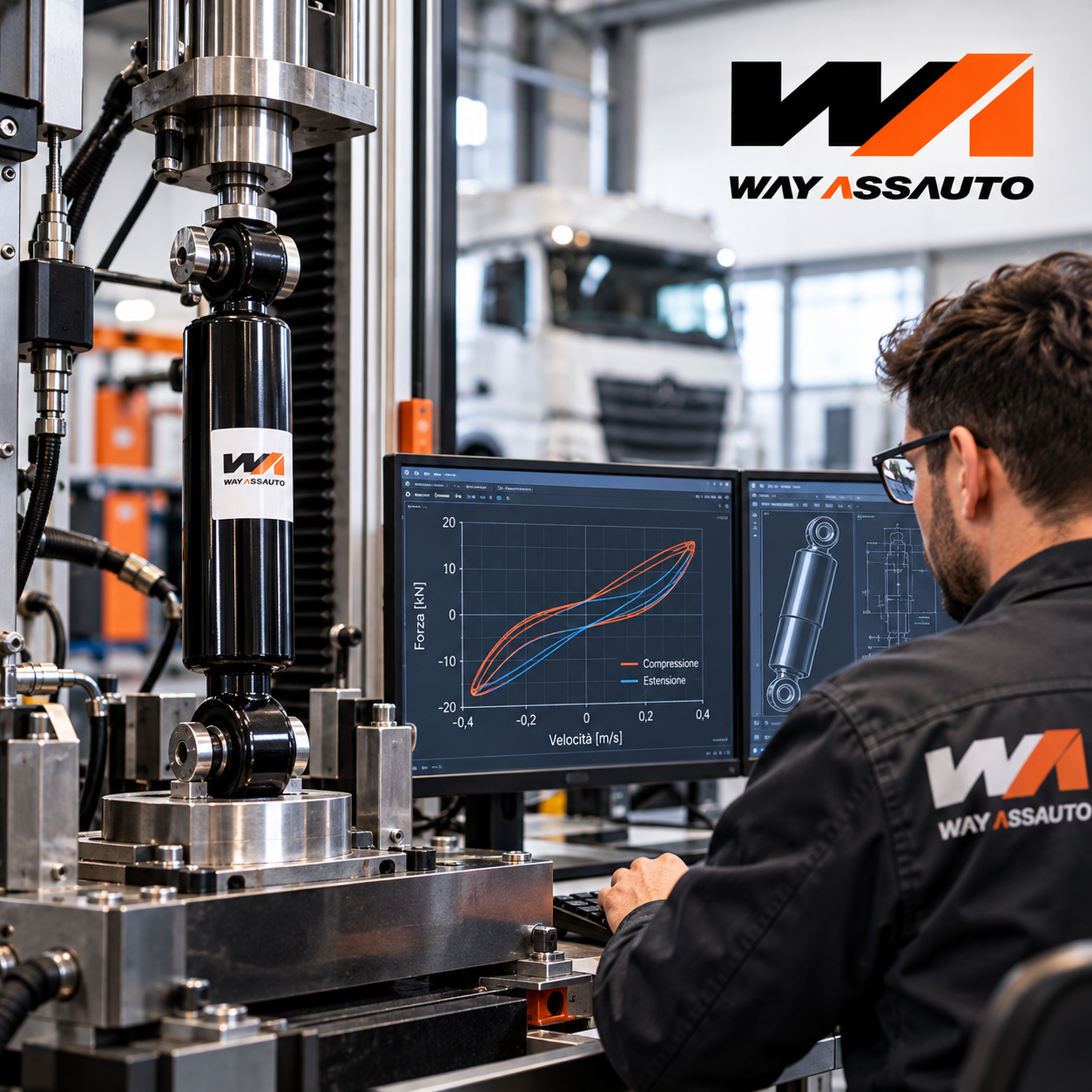
From the road to the test bench: how the conditions of use guide the development of shock absorbers
Lo development of shock absorbers starts from understanding the application. Before defining geometries, materials and damping characteristics, it is necessary to know the conditions in which the component will have to work. Loads, movements, dimensions and operating environment contribute to outlining the project requirements.
The connection between road and test bench consists precisely in transforming these needs into verifiable parameters. It does not mean reproducing every real situation without distinction, but identifying conditions and checks relevant to the objective of development.
For Way Assauto, an industrial company based in Asti and an Innovation Center in Turin, the comparison of application needs accompanies the design process.
Conditions of employment: what information to collect
A shock absorber intended for the cab of a truck works in a different context than that intended for an axle, a bus or a special application. Even within the same family, different configurations may require dedicated evaluations.
The initial information gathering should clarify:
- component function;
- mounting position and geometry;
- expected movements and loads;
- available space;
- environmental conditions;
- performance objectives;
- integration constraints.
The more these elements are defined, the more the technical comparison can focus on actual needs. Photographs and drawings help, but must be accompanied by information on the application.
From need to technical specification
The technical specification links the initial request to the characteristics to be designed and verified. Expressions such as “greater comfort” or “more control” must be explored in depth to understand what behavior you want to achieve and under what conditions.
It is also necessary to distinguish the essential requirements from the preferences and constraints still to be confirmed. An available footprint, a connection configuration or an operating condition can influence subsequent choices.
This phase makes expectations explicit and allows you to agree on the scope of the project before proceeding.
Design and prototype: verify your choices
The design translates the requirements into a component configuration. Geometry, connections, hydraulic circuit and materials must be evaluated together, in relation to the application.
The prototype allows you to delve deeper into choices through defined checks. It does not automatically represent a product ready for supply: its role depends on the development phase and the agreed objectives.
During this process, aspects that need to be reviewed may emerge. Documenting changes and configurations allows you to compare results without confusing different versions of the component.
Shock absorber test: Read the results in context
I shock absorber test they must answer specific questions. The verification of the damping behavior, a durability test and a dimensional check have different purposes.
To interpret a result it is necessary to know the configuration of the component, the test conditions, the tools used and the evaluation criteria. An isolated value does not describe the entire behavior of the shock absorber.
Comparing two configurations also requires consistent conditions. The documentation of the tests helps to understand which requirements have been verified and which further investigations remain necessary.
From the test bench to the application
The laboratory result must be evaluated with respect to the system into which the component will be integrated. When foreseen by the project, checks on the application complete the process with information on behavior in the conditions considered.
The focus also concerns attacks, connected elements and interactions with the system. The component is then examined in its context, maintaining the connection between initial requirements and checks carried out.
This step allows you to evaluate the coherence of the choices before the subsequent development or industrialization phases.
Shock absorber development between Asti and Turin: comparison with Way Assauto
Way Assauto combines its industrial experience in Asti with the skills of the Innovation Center in Turin.
To start a comparison, prepare a description of the application, known constraints, and available documentation.
Contact he teams Way Assauto: info@wayassauto.com · +39 0141 1788335.
Leave a Reply