

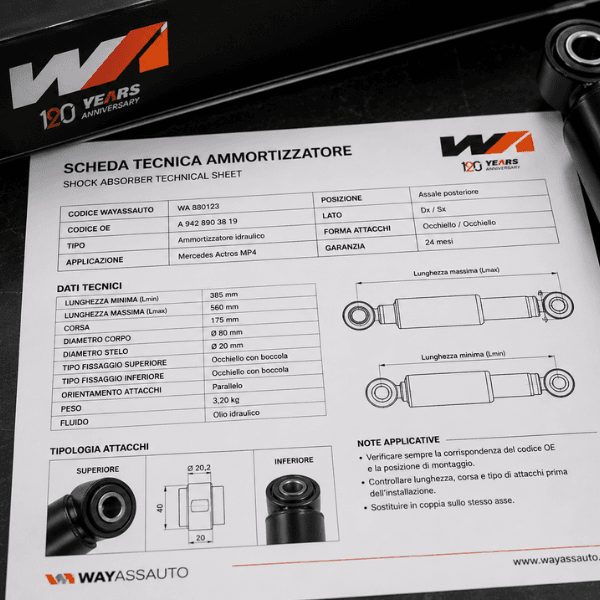
Technical data sheet of a shock absorber: measurements, connections and characteristics to check
Choosing a shock absorber for trucks or industrial vehicles requires much more than a simple visual comparison. Two components may appear identical and have similar dimensions, but be designed for different applications and conditions of use. To identify the correct product it is therefore essential to know how to read the shock absorber technical data sheet and carefully verify any available information.
Measurements, stroke, type of connections and mounting position are some of the data that help spare parts dealers, distributors and workshops to avoid incompatibilities and errors during replacement.
How to read the technical data sheet of a shock absorber
The technical data sheet collects the main dimensional and application characteristics of the component. This data allows you to compare the shock absorber to be replaced with the product identified in the catalogue.
Correct consultation helps to verify:
- compatibility with the vehicle;
- mounting position;
- component dimensions;
- typology of attacks;
- excursion available;
- correspondence with any OE codes.
The card therefore represents an important selection tool, but must always be interpreted together with the specific information of the vehicle.
Minimum and maximum length of the shock absorber
Among the first data to check are the minimum and maximum length of the shock absorber.
The minimum length, also called compressed length, indicates the size of the component when it reaches the maximum expected compression. The maximum length, however, corresponds to the measurement detected in the extension condition.
These values must be compatible with the suspension movements. A shock absorber that is too short or too long may not work correctly throughout the entire travel, subjecting attachments and connected components to unexpected stresses.
It is also important to verify the exact points between which the measurements are taken, because the method can vary depending on the configuration of the attachments.
Shock absorber travel: what does it indicate in the technical data sheet?
The stroke represents the useful distance that the shock absorber can travel between compression and extension. It generally derives from the difference between maximum and minimum length, according to the measurement criteria indicated by the manufacturer.
Adequate travel allows the component to correctly follow the movements of the suspension and control its oscillations.
However, you shouldn't choose a shock absorber based solely on the ride. Two products with similar values may have different attachments, internal structure and damping characteristics.
Type and size of attacks
The attachments connect the shock absorber to the frame, axle or other elements of the suspension system. They can take on different configurations, including:
- eyelet;
- pin;
- bushing;
- fork;
- combined attacks.
In addition to the shape, diameter, width, thread, orientation and dimensions of the bushings must be checked. Even a difference of a few millimeters can prevent correct installation or compromise the functioning of the component.
Position and application of the shock absorber on the vehicle
The sheet must indicate whether the shock absorber is intended for the axle, cab, trailer or other application. When applicable, the side and mounting position must also be checked.
A component designed for cab suspension does a different job than a shock absorber intended for the axle. The stresses, loads and required characteristics are not the same, even when the external dimensions appear comparable.
Why aren't shock absorber measurements alone enough?
A shock absorber is not defined only by its measurements. Inside, valves and fluid control compression and rebound according to a calibration developed for a specific application.
Installing a product that is dimensionally compatible but characterized by a different calibration can change comfort, stability and oscillation control. For this reason the comparison must also include OE code, vehicle, configuration and intended use.
How to check the correct shock absorber for your truck
Before ordering it is advisable to collect:
- code present on the component;
- make, model and year of the vehicle;
- chassis number;
- mounting position;
- measurements taken;
- photographs of the attacks.
The WayAssauto catalog allows you to consult the range and identify the available applications. If in doubt, technical support can help you verify information before purchasing.
Correctly reading the technical data sheet of a shock absorber means reducing errors, returns and downtime of the vehicle, choosing a component truly suitable for the intended application.
Leave a Reply