Railway Yaw Damper: what it is, how it works and why it is fundamental for train stability
In the modern railway sector, safety, passenger comfort and train stability depend on numerous components designed to work in perfect synergy. Among these, one of the most important is undoubtedly lo Yaw Damper ferroviario, an essential element of the suspension system that contributes to improving the dynamic behavior of the train during travel.
Ma what is a Yaw Damper, how does it work and why is it such an important component in modern railway vehicles? Let's find out together.
What is a Railway Yaw Damper?
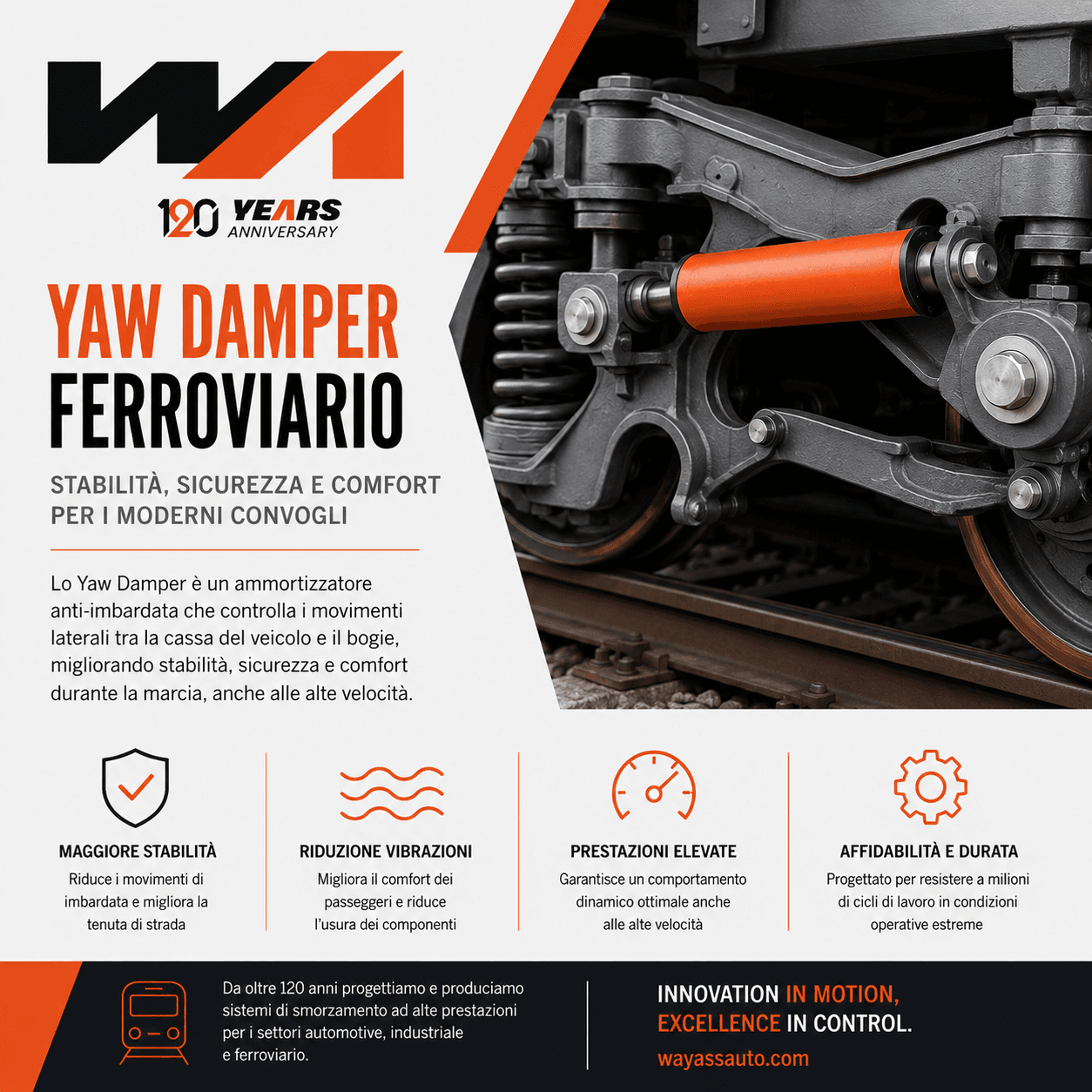
Lo Yaw Damper, also known as anti-yaw damper, is a particular type of shock absorber installed between the body of the railway vehicle and the bogie (bogie).
Its main task is check yaw movements, i.e. the lateral rotations that can occur when cornering, changing direction or at high speeds.
Thanks to its damping action, the Yaw Damper limits unwanted oscillations, improving the dynamic behavior of the train and increasing passenger comfort.
How does a Yaw Damper work?
The functioning of the Yaw Damper ferroviario It is based on the principle of hydraulic damping.
When the bogie tends to rotate relative to the body of the vehicle, the internal piston of the shock absorber generates a controlled resistance to the movement.
This damping force allows you to:
- reduce transverse oscillations;
- limit yaw movements;
- improve convoy stability;
- increase comfort while driving;
- guarantee greater safety even at high speeds.
The result is a smoother, more stable and quieter ride.
Why is the Yaw Damper so important?
In modern railway systems, especially in high-speed trains and trains intended for passenger transport, stability represents a fundamental requirement.
A High quality Yaw Damper allows you to:
Improve train stability
By limiting the movements between the box and the trolley, the train maintains a more stable trajectory even in the presence of curves or variations in the geometry of the track.
Reduce vibrations
Vibrations not only affect passenger comfort, but can accelerate the wear of numerous mechanical components.
Effective damping helps extend the life of the entire suspension system.
Increase safety
More precise control of dynamic movements means better adhesion between wheel and rail and greater operational safety.
Where is the Yaw Damper used?
The anti-yaw shock absorbers they find application in numerous types of rolling stock:
- high-speed trains;
- regional trains;
- subways;
- locomotive;
- passenger carriages;
- freight convoys;
- special railway vehicles.
Each application requires specific characteristics in terms of damping force, durability and stress resistance.
What are the benefits of a quality Yaw Damper?
Choose one Yaw Damper designed to high quality standards means obtaining numerous benefits:
- greater reliability of the railway system;
- reduction of maintenance costs;
- less wear of wheels and trolleys;
- longer component life;
- better comfort for passengers;
- excellent dynamic behavior at high speeds;
- greater safety throughout the vehicle's life cycle.
For this reason, the design and testing of railway shock absorbers represents a fundamental phase in the development of any modern suspension system.
The importance of testing and design
A Yaw Damper ferroviario it must guarantee constant performance even after millions of work cycles.
For this reason, rigorous laboratory tests are carried out which simulate real operating conditions.
Design activities include:
- dynamic simulations;
- CAD design;
- prototyping;
- fatigue tests;
- functional tests;
- dimensional checks;
- qualitative checks.
Only through a complete development process is it possible to obtain reliable components that comply with the standards required by the railway sector.
Way Assauto experience in the railway sector
From beyond 120 years, Way Assauto develops and produces high-performance damping systems for the automotive, industrial and railway sectors.
Thanks to your own Innovation Center, the company designs innovative solutions to meet the needs of railway manufacturers and international operators, constantly investing in research, development and quality control.
The goal is to offer reliable, high-performance railway shock absorbers designed to guarantee safety, comfort and long life even in the most demanding applications.
Leave a Reply