

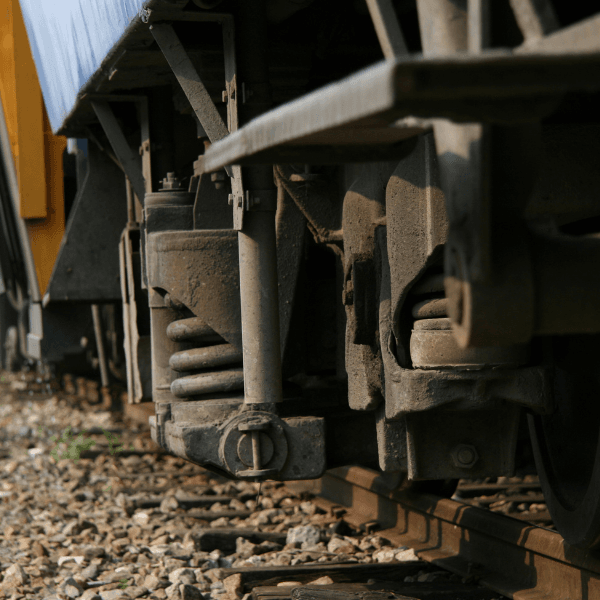
Because trains don't swing like we think
When we observe a moving train, especially at high speed, we tend to imagine it as a vehicle subject to continuous oscillations and vibrations. In reality, modern rail transport is designed to guarantee high levels of stability, safety and comfort, even on long routes and at high speeds.
Behind this apparent simplicity lies a complex system of railway suspensions and damping devices that constantly work to control the movements of the train and reduce the stresses transmitted to passengers and the vehicle structure.
Oscillations exist, but they are controlled
During travel, a train is subject to various dynamic forces generated by the speed, curves, irregularities of the railway line and the interaction between wheel and rail.
These forces can cause:
- lateral oscillations;
- vertical movements;
- vibrations;
- yaw phenomena;
- structural stresses.
Without adequate control systems, such movements would negatively affect railway safety, passenger comfort and the life of vehicle components.
The role of railway suspensions
Railway suspensions represent one of the fundamental elements to guarantee the stability of the train.
Their task is to absorb irregularities in the line and correctly distribute the forces generated during travel. Thanks to increasingly advanced systems, suspensions reduce vibrations and maintain correct contact between wheel and track.
This aspect is particularly important in high-speed trains, where even minimal oscillations could quickly amplify.
How vibrations in trains are controlled
In addition to suspension, rail vehicles use specific damping systems designed to limit unwanted train movements.
Among these we find components dedicated to the control of lateral, vertical and torsional oscillations which contribute to keeping the vehicle stable even in the most demanding operating conditions.
The objective is twofold:
- increase travel comfort;
- ensure high safety standards.
Effective control of railway vibrations makes it possible to reduce wear on components and improve the reliability of the entire system.
Because comfort depends on stability
When we travel by train, we often do not perceive the work done by the suspension and damping systems. Yet much of the comfort we experience while traveling comes precisely from their ability to control oscillations.
The reduction of unwanted movements allows you to:
- limit the vibrations perceived by passengers;
- improve the quality of travel;
- increase vehicle stability;
- reduce stress on the railway structure.
For this reason, comfort and safety are closely linked aspects.
The importance of innovation in the railway sector
With the evolution of railway mobility, the need to develop increasingly advanced solutions for controlling vehicle dynamics also grows.
Way Assauto has been operating in the railway sector for years through the design and development of systems dedicated to the control of train vibrations and oscillations. Thanks to skills gained in the automotive, industrial and railway sectors, the company contributes to the development of components designed to guarantee reliability, stability and high performance.
A technology that we often don't see
Trains oscillate much less than we imagine, not because the forces involved are absent, but because they are constantly controlled by sophisticated suspension and damping systems.
Behind every comfortable and safe journey there is design and research work that involves advanced technologies and highly specialized components. It is precisely thanks to these solutions that rail transport continues to represent one of the safest, most efficient and reliable means of transport in the world.
Leave a Reply